
Doha Qatar Startup Scene for Founders: Guide 2026

Building in MENA? You don't have to do it alone.
Join 300+ founders in the Founder Connects Residency. Monthly squad calls, warm intros, $3M+ in perks, and much more. All for less than your monthly coffee budget.

You're probably in the same spot many UAE founders hit after finding some traction at home. Dubai gave you customers, a cleaner setup path, and a decent density of investors, but the next move isn't obvious. Riyadh looks bigger. Saudi budgets are hard to ignore. Then Doha starts showing up in conversations, on founder WhatsApp groups, and in ecosystem round-ups.
The question isn't whether Qatar has momentum. It does. The question is whether that momentum translates into a sensible expansion move for your startup right now.
That's where most content on the Doha Qatar startup scene for founders falls short. It either oversells the opportunity or turns into a directory of incubators, free zones, and government entities without telling you what succeeds on the ground. Founders don't need another list. They need a decision filter.
If you're expanding from the UAE, Doha can make sense. But only for a specific kind of company, a specific sales motion, and a specific stage. If your business depends on broad consumer scale fast, you need to be careful. If you sell into regulated industries, infrastructure, enterprise workflows, logistics, mobility, or government-adjacent use cases, the equation changes.
Is Doha the Next Move for Your Startup
Most UAE founders looking at Doha are trying to answer three things quickly.
- Is there enough demand to justify the distraction
- Can I get customers without building a full team there
- Will government support help, or just create more meetings
That's the right lens.
Doha is not the next Dubai. Treating it that way usually leads to bad expansion decisions. It's a smaller market, more relationship-driven, and much more dependent on whether your product fits institutional demand. If you enter expecting fast, broad, bottom-up adoption, you'll likely spend months in polite conversations that go nowhere.
If you enter with a targeted account list, a pilot-ready product, and a clear understanding of who benefits internally from deploying your solution, you've got a better shot.
A simple framing helps:
- Good fit for Doha: B2B software, B2G tools, climate or energy-adjacent tech, logistics products, compliance workflows, procurement-friendly solutions, sports and event infrastructure tech
- Weak fit for Doha: broad consumer apps, undifferentiated marketplaces, products that need large self-serve demand, businesses that depend on constant high-volume customer acquisition
- Borderline fit: fintech, healthtech, edtech, and AI tooling. These can work, but only when the buyer is clear and the deployment path is practical
Practical rule: Don't ask whether Doha is “hot”. Ask whether a Qatari corporate, operator, or ministry-linked buyer can approve a pilot for what you sell.
For a regional benchmark, it helps to read a wider MENA startup ecosystem guide before deciding where Qatar sits in your expansion order.
A lot of founders also underestimate the operational burden of “light” market entry. Even when you don't hire immediately, you still need local context, introductions that carry weight, and enough follow-up discipline to convert initial interest into procurement movement. Doha rewards patience, but it doesn't reward vagueness.
The Doha Startup Scene by the Numbers
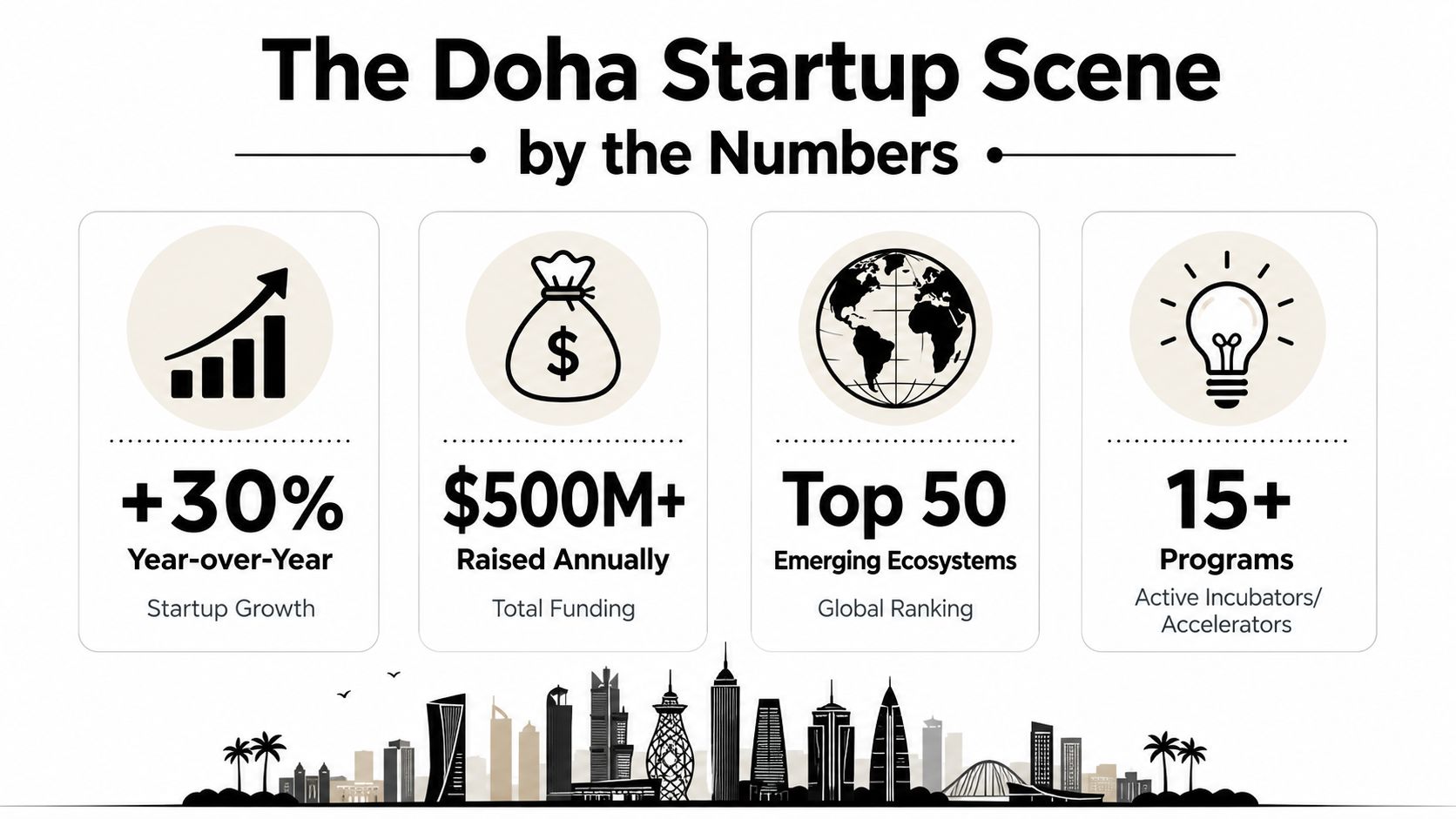
A UAE founder looking at Doha should read the numbers with one question in mind. Is this a market big enough to justify real attention, or just interesting enough to fill a slide deck?
The answer sits somewhere in the middle.
According to Startup Qatar's ecosystem overview, Qatar's startup ecosystem grew 43.5% in 2025, now ranks #73 globally, includes 87 startups, and has total funding exceeding $35.46 million. The same source says startups attracted $254 million in announced investments in the first eight months of 2025, alongside a 17% increase in the total number of deals. It also notes that founders can access support including funding of up to QAR 4 million, approximately USD $1.1 million, through its platform.
Those figures are useful, but only if you read them against the size of the market.
Fast growth from a small base is still a small base. That is not a criticism. It means Doha should be judged as a focused second market, not as a Dubai substitute.
What the numbers support
A few points are clear from the same source, even without overstating them:
- The support system is getting more organised: Startup Qatar is positioning itself as a clearer entry point for founders who want to assess programmes, incentives, and setup options.
- Deal activity is widening: A 17% increase in deal count points to more companies getting attention, not only a handful of headline rounds.
- Qatar is trying to make company formation founder-friendly: The source cites strong rankings for the broader business environment, which matters if you are comparing setup friction across Gulf markets.
What a founder should not assume
These numbers do not mean Doha has the buyer depth, founder density, or operator bench of the UAE. They do not mean every startup category can justify local hiring. They also do not mean announced investment will translate into accessible capital for every foreign founder entering from Dubai or Abu Dhabi.
That is the trade-off.
Doha is becoming easier to assess and easier to enter. It is still harder to scale in if your product depends on volume, wide mid-market demand, or constant customer acquisition.
For a founder expanding from the UAE, the practical read is straightforward. Doha is credible enough to test seriously, especially if your path to revenue runs through a concentrated set of enterprise or government-linked buyers. It is still small enough that you should earn traction before building cost around the market.
Use the numbers as a filter, not a signal to overcommit.
Where to Find Real Opportunities in Doha
If you want the short version, revenue in Doha is more likely to come from venture-client relationships than from broad market pull.
That's the centre of gravity many founders miss.

According to Startup Genome's report on how Qatar activates markets for startups, venture funding in Qatar reached $58.7 million (QAR 214 million) in 2025, nearly doubling year on year. The same report says 93% of deals were concentrated at early stages, where corporate validation and pilot opportunities matter most, and notes that large corporates such as Qatar Airways and government entities are engaging startups through structured procurement pathways. It also highlights the Ministry of Commerce and Industry's Scale Now programme, QRDI Council grants tied to industry challenges, and over 22+ incubators in a system moving towards a venture-client model.
The sectors where Doha is most practical
You don't need to chase every vertical. You need to find where spending, policy interest, and buyer urgency overlap.
- Logistics and mobility: Strong if your product helps with fleet visibility, routing, supply movement, customer operations, or infrastructure efficiency.
- Energy and industrial workflows: Better suited to B2B tools than consumer products. Think maintenance, reporting, safety, compliance, and operational intelligence.
- Sports and event-related tech: Qatar still has relevance here, especially where products connect venue operations, fan systems, security, performance analytics, or event logistics.
- Food systems and resilience: Useful if you solve a hard operational problem instead of just offering another marketplace layer.
- Government workflow digitisation: This can be attractive when your product reduces friction in approvals, service delivery, case handling, or reporting.
The model that tends to work
In Doha, many founders win by selling a pilot before they sell a full rollout.
That means your deck needs to answer different questions:
- Who owns the problem internally
- How fast can the pilot go live
- What data, compliance, or procurement blockers exist
- What success metric matters to that buyer
- What happens after a successful pilot
If you can't answer those five points in plain language, you're not ready for Qatar yet.
A useful primer on the ecosystem's business-facing direction is below.
What doesn't work well
Founders waste time in Doha when they rely on abstract innovation language. “AI-powered”, “regional scale”, and “transforming the future” don't help a buyer decide. Procurement-oriented environments want clarity, references, risk control, and implementation discipline.
If your product can't survive a pilot with defined deliverables, it probably won't survive Doha's buying process either.
The upside is that once a buyer takes you seriously, the path to early revenue can be more concrete than in ecosystems where everyone wants to “stay in touch” and nobody owns a budget.
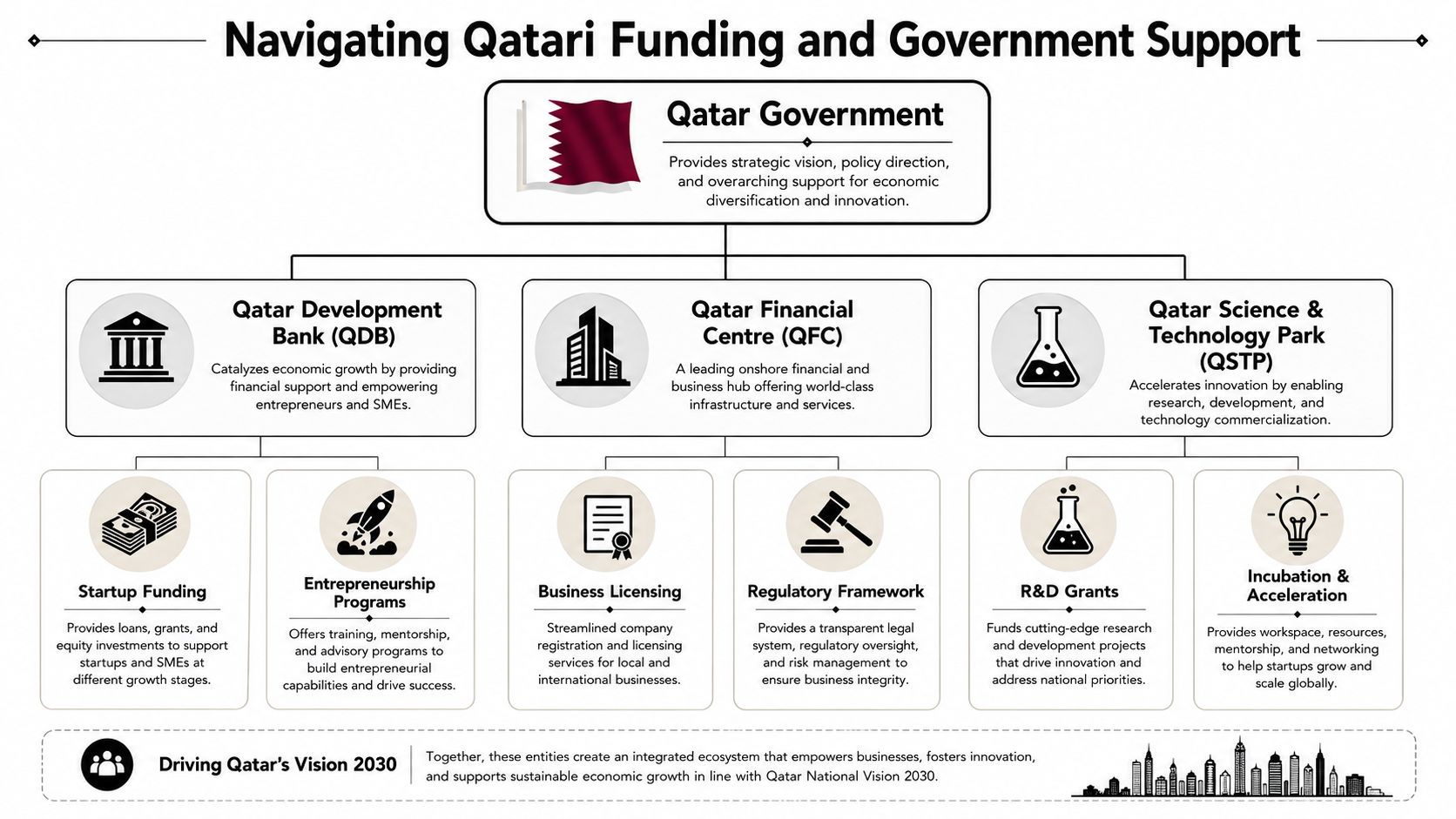
Navigating Qatari Funding and Government Support
Most founders entering Qatar don't struggle because support doesn't exist. They struggle because the support stack is hard to access cleanly from the outside.
That's especially true with QDB.
According to a founder-focused discussion on QDB's role and founder pain points, many early-stage Doha founders know Qatar Development Bank is central, but don't know which programme matches their stage or how to move from incubation to acceleration to VC support inside QDB's integrated model. The same discussion points to a real bottleneck around CFO-level support and the lack of a simple onboarding map for first-time founders.
How to approach the support landscape
Think of the system in layers, not logos.
First layer is entry and positioning
Use Startup Qatar and Invest Qatar as orientation points. They help you understand what support exists, what category you fit into, and whether your company should approach the market as a local incorporation candidate, an expansion-stage entrant, or a programme participant first.
Your first call shouldn't be “how do I get funded”. It should be “given my stage, business model, and current revenue, which support path should I test first”.
Second layer is programme fit
QDB matters, but don't approach it vaguely. Go in with a one-page stage summary:
- Current stage: validation, early revenue, post-pilot, or expansion
- Primary ask: customer access, grant support, licensing clarity, capital, or financial planning help
- Deployment proof: where the product already works
- Qatar angle: why this market specifically
That one page forces sharper conversations. It also helps contacts route you internally.
Third layer is investor readiness
When you do speak to investors or programme managers, your pitch needs to be tighter than usual. Qatar is still compact enough that weak narratives travel quickly. If you want a practical reference on structuring effective investor pitches, use it to sharpen your story before you start outreach.
You can also review broader government-backed accelerators and public sector programmes across the region to compare how Qatar's support model differs from more market-led ecosystems.
Navigating Sharia-compliant VC
A development worth paying attention to is a newer funding lane for founders who want capital aligned with Sharia principles.
A founder-focused ecosystem note reports that Lesha Bank and Doha Tech Angels launched a joint Sharia-compliant VC initiative in 2026 aimed at providing funding for tech founders, while practical guidance on how to apply, qualify, and pitch remains limited, as referenced in this announcement context.
| Funding Channel | Initiative | What Founders Need to Know |
|---|---|---|
| Sharia-compliant venture capital | Lesha Bank and Doha Tech Angels joint initiative | Don't assume a standard VC pitch is enough. Be ready to explain how your structure, use of funds, and commercial model fit Sharia-sensitive expectations. |
| Bank-linked founder conversations | Lesha Bank pathway | Ask early what documents, governance setup, and funding instrument details they expect. Don't wait until diligence. |
| Angel-led access | Doha Tech Angels side of the initiative | Warm introductions matter. The practical application process may still feel unclear, so founder referrals can reduce ambiguity. |
What founders should do differently
If you're exploring this route, ask direct questions in your first meeting:
- What funding structure is being used
- What business models are easiest to assess
- What governance or documentation needs to be in place before review
- What does a strong first meeting deck include
- How do they evaluate tech startups that already raised on conventional terms
Operator's note: In Qatar, the quality of your questions often signals founder maturity more than the polish of your branding.
The mistake is treating every funding body the same. The win comes from matching your stage, structure, and ask to the right door.
Is Doha Your Best Second Market After the UAE
For many founders, the answer is “sometimes, but not by default”.
If you're already operating in the UAE, Doha is usually a precision expansion, not a scale expansion. That means it works best when you know exactly why you're going there.
A simple founder scorecard
| Criteria | Doha | UAE |
|---|---|---|
| Local market breadth | Smaller and more selective. Better for targeted account penetration than broad demand generation. | Wider commercial base and more category depth. |
| B2B and B2G access | Strong when you have warm introductions and a pilot-friendly offer. | Broader set of private buyers, but also more vendor noise. |
| Competition | Lower saturation in some sectors. Easier to stand out if your category is relevant. | More mature and more crowded. Stronger competition in most software categories. |
| Ecosystem density | Supportive but compact. Fewer random opportunities, more need for intentional outreach. | Higher founder density, more events, more service providers, more investor visibility. |
| Talent and operating model | Better approached lean at first. Don't assume you need a full local build-out. | Easier to assemble regional teams and service support. |
| Expansion logic | Best as an account-led move. | Best as a base market and regional operating centre. |
When Doha is a strong second market
Choose Doha earlier if these statements are true:
- Your product sells well through pilots
- Your ideal customer is a large enterprise, public entity, or regulated operator
- You already have proof from UAE deployments
- Your team can handle relationship-led sales without needing immediate volume
- You're entering with specific targets, not general curiosity
When to delay it
Wait if your company still needs product clarity, your sales process is chaotic, or your category depends on large numbers of self-serve users. In those cases, the UAE usually gives you more room to refine before adding another market.
A helpful check before you decide is this UAE startup expansion checklist for GCC markets. It's useful for pressure-testing whether you're expansion-ready or just restless.
Doha is a good second market when it sharpens your sales motion. It's a bad second market when it distracts you from fixing the core business.
That's the honest trade-off. Less noise. Less breadth. Sometimes more focused opportunity.
Your First Steps to Test the Waters
You don't need to book a flight first. You need to run a structured test.
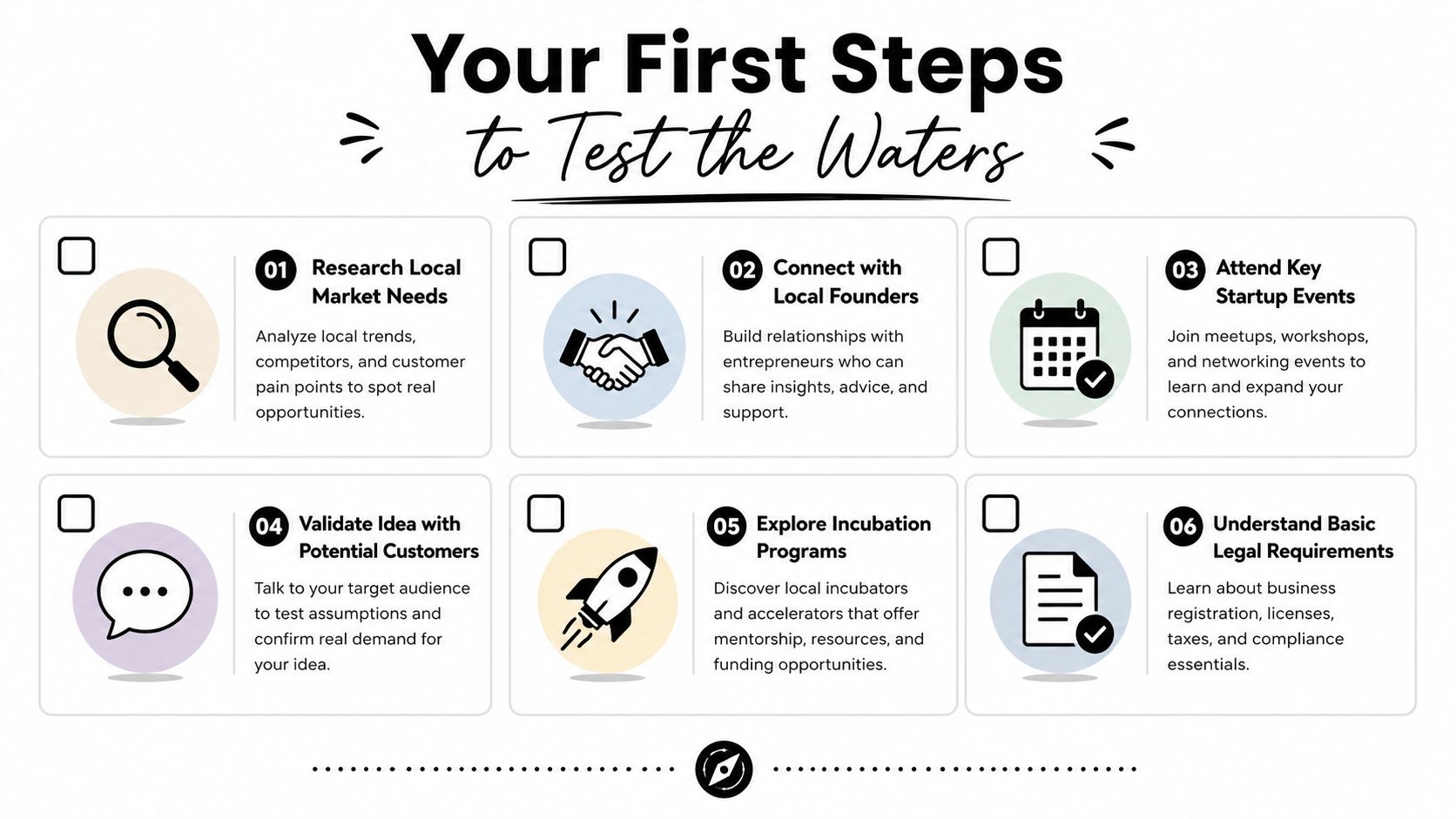
A practical 30-day plan
Week 1. Build a target list
Pick ten organisations in Doha that could plausibly buy your product. Mix corporates, government-adjacent entities, and ecosystem enablers. Then write one sentence for each on why they should care now.
Week 2. Run founder and operator interviews
Speak to founders already selling in Qatar. Ask what moved slowly, what opened doors, and which titles owned budget. Good questions beat generic networking every time.
Week 3. Test outreach
Send short, specific messages on LinkedIn or email. Don't ask for “advice”. Ask whether your product is relevant to a live operational problem, and whether they'd take a short call to assess pilot fit.
Week 4. Stress-test market entry
Review your deck, pilot scope, procurement readiness, and internal ownership. If someone says yes tomorrow, can you start without rebuilding the company around one market?
Use this quick checklist as you go:
- Refine your buyer thesis: name the department, not just the company
- Collect objections: track every reason a conversation stalls
- Map local support options: note which programme or fund matches your stage
- Look for local champions: one credible operator can generate more than ten cold intros
- Keep the test cheap: don't hire, relocate, or overbuild until demand is real
- End with a decision memo: after 30 days, decide go, pause, or revisit later
Doha is worth serious attention. It isn't worth vague attention.
If you want a higher-signal way to think through expansion, fundraising, and founder decisions with people who are actively building in the region, Founder Connects brings UAE and MENA founders into curated peer groups, practical conversations, and meaningful introductions that help turn scattered market interest into clearer next steps.

Building in MENA? You don't have to do it alone.
Join 300+ founders in the Founder Connects Residency. Monthly squad calls, warm intros, $3M+ in perks, and much more. All for less than your monthly coffee budget.
Popular posts





Founder Connects is a premium MENA tech founder community. Meetups in Dubai and across MENA, Residency Squads of 8–10, and 400+ vetted WhatsApp founders (apply and screened).