

Founder Meetups for Edtech Founders in Dubai

Building in MENA? You don't have to do it alone.
Join 300+ founders in the Founder Connects Residency. Monthly squad calls, warm intros, $3M+ in perks, and much more. All for less than your monthly coffee budget.

Edtech founders in Dubai can use the Founder Connects Meetup calendar to meet other builders working on learning products. Bring one specific question, such as school sales cycles, pilots or parent and student acquisition, rather than a full pitch. Coffee Series suits a focused table conversation, and Tech After Hours suits an informal evening with other builders.
Building an education product comes with slow buying calendars, sceptical gatekeepers and long feedback loops between classroom trials and renewals. Waiting months to see whether a trial structure or onboarding flow holds up burns runway fast. Comparing notes at founder Meetups for edtech founders in Dubai turns weeks of guesswork into a direct conversation with people solving comparable operational puzzles.
The difference between a wasted evening and a useful one rarely comes down to charisma. It comes down to picking the right Meetup format for the job, understanding how peer mentoring works without a formal teacher and arriving with one tightly framed question that invites real experience rather than polite nods.
Which Meetup Suits an Edtech Founder
Which room should an edtech founder choose first, and why does that choice change the quality of the conversation? Treat the Meetup like a test bench for one live question. A founder working on school sales cycles, pilots, or parent and student acquisition should arrive with that decision in hand, not with a full company story. Founder Connects is a startup community in Dubai and the world, with Meetups in Dubai and in cities around the world, so an education builder can find peers close enough to understand the local market and practical enough to compare notes.
Founders apply and are screened before joining the WhatsApp group. That keeps the room focused on people taking founder work seriously. It also means a builder can skip the basic definitions and spend the evening on the issue at hand: where a school pilot stalled, how a buying calendar moved, or which parent message earned a reply.
Comparing the Five Meetup Formats
Each Meetup serves a distinct commercial or product job. Use the comparison below to pick the single format that fits what is blocking the business this month.
| Meetup | Best use for an edtech founder |
|---|---|
| Pitch Night & Mixer | Test how a product story lands with peers before a sales conversation |
| Cofounders Wanted | Search for a technical or education-sales cofounder for a learning product |
| Coffee Series | Work through one specific question, such as a school pilot or a sales cycle |
| Tech After Hours | Meet other builders and hear which product problems they are solving |
| The Playbook | Learn how other founders run lead generation, AI features and fundraising |
Notice how each format narrows the goal. A solo curriculum designer who needs a full-stack engineer or an education-sales partner belongs at Cofounders Wanted, a Meetup focused on cofounder roles such as a CTO, CPO, growth lead or CEO. A casual evening is a poor substitute when the missing piece is a cofounder with the right operating role. Once a founder has tightened the core value proposition and wants to see whether a short narrative makes sense aloud, Pitch Night & Mixer, a Meetup with founder stories and short pitches followed by a mixer, gives that story a controlled stress test before a school director meeting.
Picking a Format by Current Bottleneck
Founders new to the calendar often overthink the first room. A simple filter removes the hesitation:
- Single live decision: Choose Coffee Series, a Meetup built around small one-table conversations, when one operational hurdle needs steady back-and-forth around one table.
- Broad builder perspective: Choose Tech After Hours, an informal evening with no agenda, no name tags and no pitches, when the goal is to hear what other founders in Dubai are shipping, struggling with and testing right now.
- Tactical growth mechanics: Choose The Playbook, an online Meetup, when the team wants founder playbooks on lead generation, AI agents, fundraising or growth.
Evaluating communities before committing time matters just as much as picking a session format, and founders weighing local options can review how to choose a startup community in Dubai to sharpen their criteria.
For a default first visit, keep the decision simple. Book one Coffee Series seat on the Founder Connects Meetups calendar and write one concrete question on a card before walking through the door.
What Peer Mentoring Means at a Meetup
Peer mentoring means founders help each other by sharing what they've tried, what went wrong and what they'd test next, without a fixed mentor or a teacher giving lessons. It is like a study circle where each builder has already solved a different problem, rather than a single tutor standing at a whiteboard lecturing on one subject.
A glimpse of how focused table conversations unfold helps separate practical peer exchange from noisy networking rooms.

When an edtech founder expects a Meetup to provide a single expert with all the answers, disappointment follows quickly. Nobody in the room knows a startup's exact curriculum, pricing or user base better than the team building it. What peers hold instead is scar tissue from adjacent mistakes, which is often far more useful than textbook advice.
Three Working Parts of Peer Mentoring
Useful peer mentoring at a Meetup relies on three practical mechanisms working together rather than vague encouragement:
- Experience exchange: A founder who has already run a school pilot walks through the exact sequence of steps, where paperwork stalled and which stakeholder held sign-off authority. Hearing the friction points saves another builder from walking into the same delay blind.
- Specific feedback: Rather than critiquing a whole company, peers react to one live choice. They might look at two ways to structure a parent onboarding flow or compare whether a short classroom trial converts better than an open-ended free tier, pointing out blind spots the builder missed.
- Accountability: Before leaving the table, the founder names one small action to test prior to the next Meetup. Knowing another builder might ask how that test went next month creates quiet pressure to execute instead of endlessly polishing slides.
Peer mentoring works best when a founder stops trying to look impressive and starts describing the exact constraint slowing the business down.
What Peer Mentoring Is Not
Confusion sets in when founders treat a peer table like a commercial funnel. Peer mentoring isn't a funding pitch, a sales call or a casual networking drink where everyone trades rehearsed slogans. Pushing a product hard shuts down honest feedback immediately, because people stop diagnosing the business and start protecting their time.
Consider a concrete edtech scenario. A founder building a homework-support tool sits down at a Meetup and skips the origin story. Instead, the founder asks how other consumer or learning builders measured whether learners returned after one week without daily reminders from parents.
Ten minutes later, the conversation surfaces a simpler retention check tied to completed practice sessions rather than raw logins. The founder leaves with one named metric to track over the next fortnight and a clear benchmark for what counts as healthy behaviour. For a broader look at why structured peer conversations pay off locally, explore the benefits of founder mentorship for UAE startups.
Before booking a seat, pick one active problem that needs outside eyes and plan to follow up with one peer whose experience maps closely to that hurdle.
How to Frame One Question for a Meetup
Bring one question, framed in five short lines, rather than a full company pitch. Stating the decision, giving two lines of context, asking a usable question, naming the next test and inviting a single follow-up turns a brief table slot into actionable advice.
Mapping those five lines visually before heading out keeps the framing crisp under time pressure.
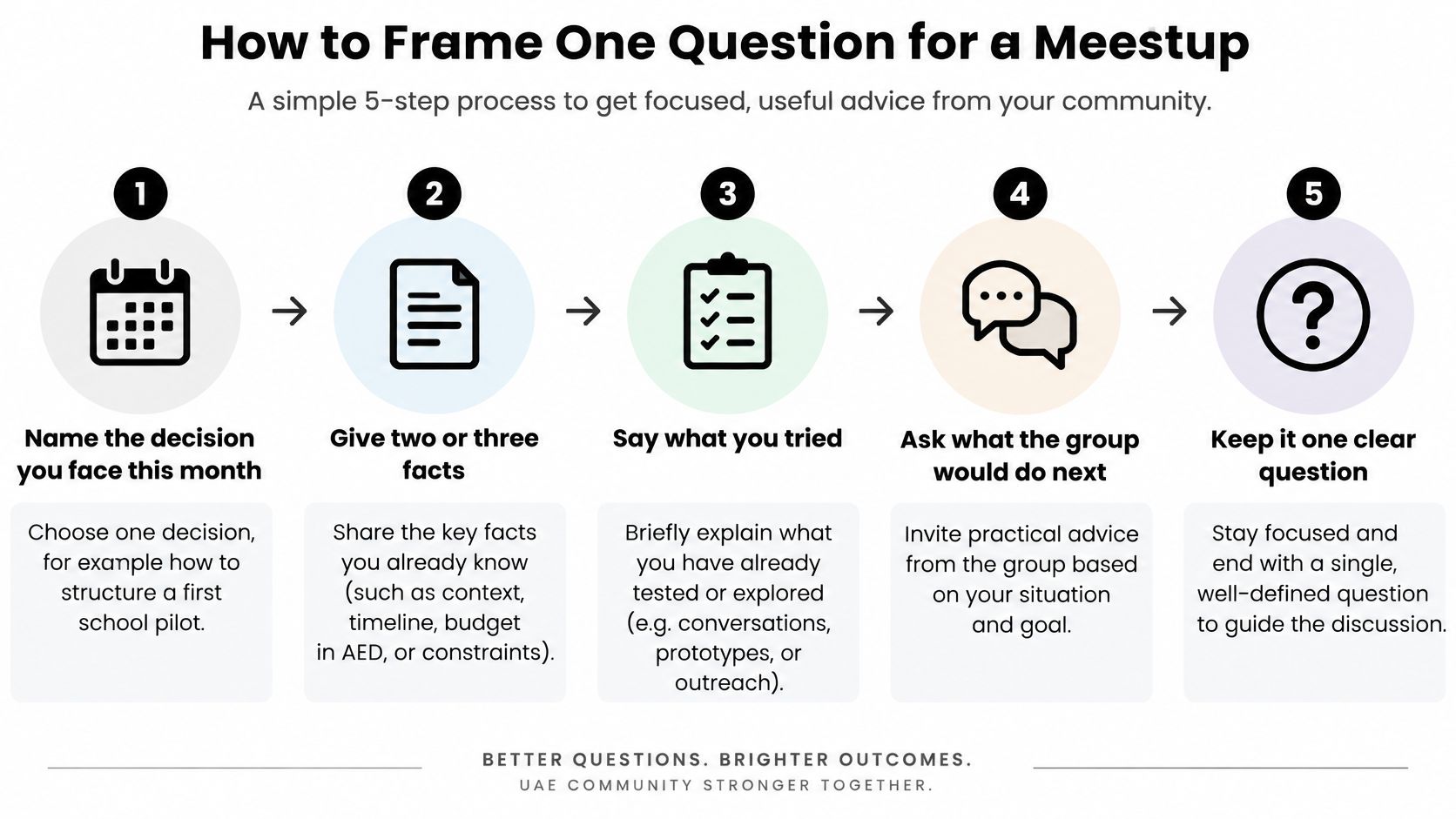
Most builders ramble at Meetups because they start with company history instead of the bottleneck in front of them. By the time they explain why education needs modernising, half the table has tuned out and nobody knows what help is needed. A tight structure fixes that problem immediately.
The Five-Line Question Frame
Build the prompt using five short parts, keeping each one stripped of buzzwords:
- Name the decision faced this month: State the concrete fork in the road, such as deciding how to structure a first school pilot. Naming the decision shows peers what's at stake so they don't offer abstract theory.
- Give two sentences of context: Mention the product stage, who currently uses the tool and what the team has already tested. Without this baseline, peers will waste five minutes suggesting tactics the team already tried and ruled out.
- Ask one question with a usable answer: Focus on an observable mechanic, such as which piece of evidence a school buyer requested before approving a trial. Broad questions trigger vague platitudes, while narrow ones surface specific stories.
- State the test to run next: Explain what the team will change if a solid answer comes back from the table. Naming a test keeps the discussion anchored to real execution rather than idle debate.
- Invite one follow-up: Offer a short follow-up call or coffee on that exact topic if someone in the room has solved it before. A clean invitation respects everyone's schedule and moves deeper troubleshooting off the main table.
Practical rule: If a peer needs to ask three clarifying questions just to understand what the startup builds and what is stuck, the opening frame is still too broad.
Weak Versus Strong Edtech Questions
Comparing two versions of the same classroom-sales problem makes the gap unmistakable.
- Weak question: "How does an edtech startup sell to schools?" It's far too wide. Nobody knows whether the product targets teachers, parents or administrators, whether it's pre-launch or already live, or what objection keeps stalling deals.
- Strong question: "The product is used in one classroom, and the head teacher wants a term-long trial before approving. What trial structure has convinced a school buyer to continue?" That version gives stage, active usage, the exact buyer objection and a clear prompt peers can answer from experience.
Fitting all five lines cleanly into the opening minute takes practice, especially when introducing a learning product to builders outside education. Reading a 60-second guide to introducing yourself at a Founder Meetup helps tighten the phrasing so the opener sounds natural rather than scripted.
Rehearse the five lines aloud twice before leaving home and time them on a phone. Trim any extra filler until the entire prompt lands comfortably under 60 seconds.
Edtech Topics Worth Bringing to a Meetup
Edtech founders get the most out of a Meetup when the question sits inside one clear topic area paired with one suitable format. Trying to unpack pricing, classroom adoption and parent acquisition in the same conversation scatters attention and leaves the founder with half-formed opinions on all three.
Education startups juggle a distinct mix of users, buyers and technical environments. Isolating one slice of the business makes it far easier for another builder, even one outside education, to spot a pattern they've handled before.
Five High-Value Topics for Edtech Builders
Keep the table conversation anchored to one of these five operational areas:
- School sales cycles: Ask who held final sign-off, how long a typical approval dragged on and what concrete proof the buyer asked to see before signing a trial agreement.
- Pilots: Compare how peers scoped a pilot tightly, which success criteria both sides wrote down before launch and what happened the week after the trial finished.
- Parent and student acquisition: Explore which early channels brought the first genuine learners, how tweaks to first-day onboarding changed repeat usage and which plain-English messages parents replied to.
- Learning outcomes: Discuss how a product team picked one credible measure of student progress and how it translated those numbers for a buyer who isn't technical.
- Product integration: Talk at a general level about which school or training platforms a learning tool had to sit alongside, and where handoffs between systems usually broke down.
Matching the Topic to Commercial Strategy and Format
A sharp question doesn't sit in isolation from the rest of the business. Builders still narrowing down who pays versus who uses the tool daily can sharpen their assumptions through edtech market entry, target audience and distribution strategy before stepping into the room. Preparation ensures Meetup time goes toward pressure-testing real choices instead of defining basic terms.
Once the topic is chosen, align it with the format that suits its depth. Deep commercial mechanics, such as untangling a multi-step school pilot agreement or structuring outcome reporting for administrators, fit Coffee Series because a small seated conversation lets peers dig into details. A looser exploration of early parent acquisition angles or messaging experiments fits Tech After Hours, which is outlined in the guide to Tech After Hours in Dubai.
Before checking the calendar, run one quick preparation test. Write down a single topic from the list above, draft one sharp question beneath it and note the Meetup format that fits best.
Edtech Founder Questions About Meetups
Builders working on learning products tend to ask the same three things before booking a first seat. Straight answers follow.
Are there founder Meetups in Dubai for edtech startups?
Yes. Founder Connects runs Meetups in Dubai and in cities around the world. A founder building a learning product rarely needs an education-only room, because the hardest edtech problems are commercial at their core: trial design, retention, pricing and onboarding look the same across sectors. A SaaS founder who has sold into institutions can pressure-test a school procurement assumption just as well as another edtech builder can.
Dates and formats are listed on the Founder Connects Meetups calendar, so checking what runs this week takes a minute.
What should an edtech founder ask at a Meetup?
Bring one specific question about a school sales cycle, a pilot, or parent and student acquisition. Treat the Meetup as a test bench for that single question rather than a stage for pitching the whole company. Peers give their sharpest input when the ask names a decision, a constraint and a deadline.
The difference shows in practice. "How do I sell to schools?" invites generic advice about education trends. "Our pilot ends in June and the school wants outcome data before renewing, so which metric have administrators accepted in your experience?" gives the table something real to work with. The second version names the decision (which metric to report), the constraint (the renewal depends on it) and the deadline (June). Aim for questions about mechanics someone else has lived through, such as shortening onboarding drop-off or structuring a school trial, because lived answers beat opinions.
Which format suits an edtech founder?
Pick by bottleneck, not by habit. The format question mostly answers itself once the current blocker is named. A decision bottleneck, where one commercial choice has been stuck for weeks, calls for depth and unhurried input, so a small seated table conversation is the right room. A people bottleneck, where the missing piece is a CTO, CPO, growth lead or CEO, points toward the cofounder-matching session. A story bottleneck, where the pitch has never been tested in front of strangers, belongs in a room built around pitching.
Founders who are not yet sure what their bottleneck is often benefit from an informal evening with other builders first, because hearing what peers are shipping tends to surface the blocker. The right starting point is whichever room forces the current constraint into the open.
Book Your Meetup Seat and Prepare
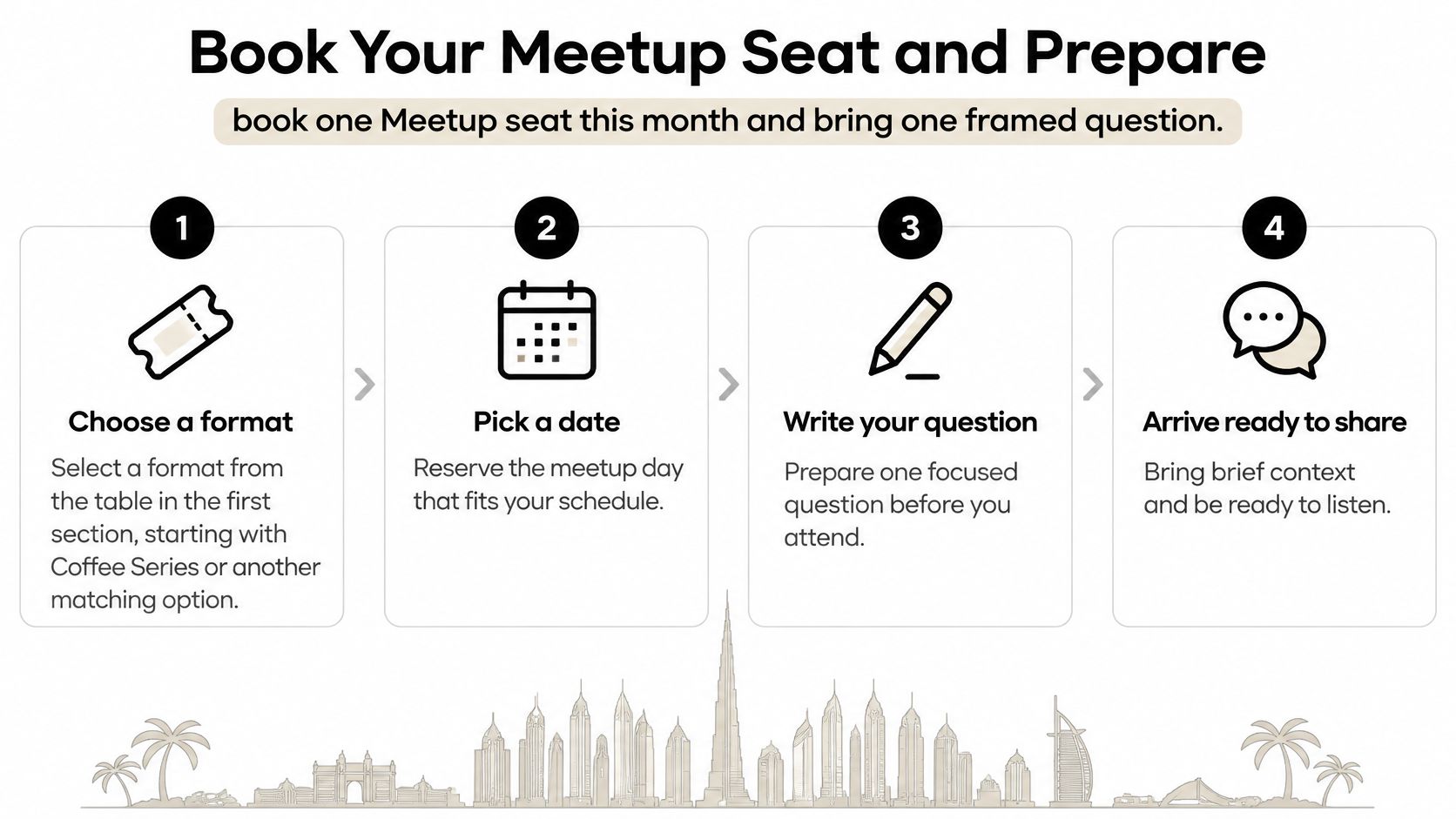
Book one Meetup seat this month and attach it to a real edtech decision, such as a school pilot, a procurement step or parent acquisition. For Meetups, attendees pick the Meetup, book their seat and show up; walk-ins are turned away because room size is capped for quality. The seat is not a ticket to generic inspiration. It works more like a reserved chair at a working table, where the value comes from the question you bring and the follow-up you make after the conversation.
Four Steps from Booking to Arrival
Follow this checklist so the session produces a concrete outcome instead of vague inspiration:
- Choose a format: Pick the session that fits the current bottleneck. Use the event descriptions to match the room to the work, whether that is a small-table conversation, a relaxed builder evening, a cofounder search, a story test or a growth playbook.
- Book your seat: Reserve a spot through the Founder Connects Meetups page well ahead of the date, since capacity is capped.
- Prepare your one-page brief: Bring a one-line product description, the decision in progress and the answer you hope to test. Keep it short enough to read before the conversation starts.
- Arrive on time and execute: Introduce the product in one clear sentence, ask the framed question when the moment opens and leave with one named follow-up agreed before standing up.
Pack light for the session. Bring a crisp one-line product description and leave space to note two peers worth following up with over the next few days. Founders attending for the first time who want a clearer picture of room flow and etiquette can skim the guide to what to expect at a Tech Founder Meetup in Dubai beforehand.
Meetups are open to the wider builder community. At Founder Connects, 1,000+ founders attended Meetups in the last few months. That matters for an edtech founder because peer input is most useful when the room includes people who understand early-stage decisions, from testing an idea to scaling. Showing up consistently with one sharp problem builds momentum over time.
Turning Table Notes into a Seven-Day Test
The return on a Meetup happens in the week after the chairs are pushed back. Notes that sit untouched in a notebook change nothing about classroom adoption or parent sign-ups. A Meetup works best as a small test bench: you bring one live question, listen for what peers have seen and then run one practical check with your own users or partners.
One small experiment shipped within seven days beats ten pages of clever Meetup notes that never reach a real user.
Pick one concrete follow-up test to run before the week ends, such as scheduling a short feedback call with a school operator, rewriting a pilot proposal around one agreed success metric or testing a shorter parent onboarding step. Bring the notes back to the product or commercial team and ask one direct debrief question: which single answer from the Meetup changes what the team does this week? That question turns a room full of discussion into a decision about the next school call, pilot document or acquisition test.
Founder Connects, a startup community in Dubai and the world, runs Meetups where founders compare notes with other builders. Book the next Meetup.

Building in MENA? You don't have to do it alone.
Join 300+ founders in the Founder Connects Residency. Monthly squad calls, warm intros, $3M+ in perks, and much more. All for less than your monthly coffee budget.
Popular posts





Founder Connects is a premium tech founder community in Dubai and the world. Meetups, Residency Squads of 8–10, and a WhatsApp group of 600+ vetted founders.