

How to Choose a Startup Community Dubai

Building in MENA? You don't have to do it alone.
Join 300+ founders in the Founder Connects Residency. Monthly squad calls, warm intros, $3M+ in perks, and much more. All for less than your monthly coffee budget.

Choose a startup community in Dubai by the specific job you need done in the next 90 days, then verify that the room contains founders and operators who can help with that exact job. Treat membership size, venue photos and investor logos as background information, not reasons to join.
Your WhatsApp is full of invitations, LinkedIn keeps serving rooftop photos, and you still don't know where to take the problem you're actually stuck on. You don't need another crowded calendar. You need a room that helps you make a better decision.
Why Most Founders Pick the Wrong Community in Dubai
A founder scrolls through invitations, recognises a sponsor's logo and books a place. The conversation is pleasant, the skyline looks good, and everyone exchanges LinkedIn profiles. Back at the desk, the customer problem remains untouched.
Visibility is easy to inspect. Practical value takes more work. That's why founders can end up choosing the most visible community rather than the most relevant one.
Dubai's investment activity doesn't remove that distinction. MAGNiTT's UAE venture investment research describes an active early-stage market alongside more selective investment conditions. My recommendation is to seek people who can challenge your assumptions and improve your preparation, not merely people who might know an investor.
Start with the decision you're avoiding
Write down the question you've been postponing. It might be whether your target customer needs the product, whether your positioning makes sense, or whether you're ready to raise.
Then describe the person whose experience would help:
- For validation: Someone who has interviewed comparable customers and can challenge your interpretation of their answers.
- For fundraising preparation: A founder who can interrogate your narrative, evidence and use of funds.
- For customer acquisition: An operator who understands your buyer and sales process.
- For accountability: Peers who'll remember your commitment and ask what happened.
A celebrated founder isn't automatically the right person. Someone working through a neighbouring problem may offer more immediately usable feedback.
Practical rule: Choose the room where you can discuss the work, not just introduce the company.
When deciding how to choose a startup community in Dubai, use a sequence: define the job, check stage and sector fit, then test an actual interaction. Don't buy a membership to compensate for an unclear objective. You'll struggle to judge the value because you haven't decided what value means.
The Six Decision Criteria That Actually Matter
Put stage fit and peer quality above attendance volume. A smaller room can be useful if members understand your constraints; a larger room can be useful if you need breadth. Neither format deserves preference without a purpose.
Use these criteria to inspect the offer before you inspect the venue.
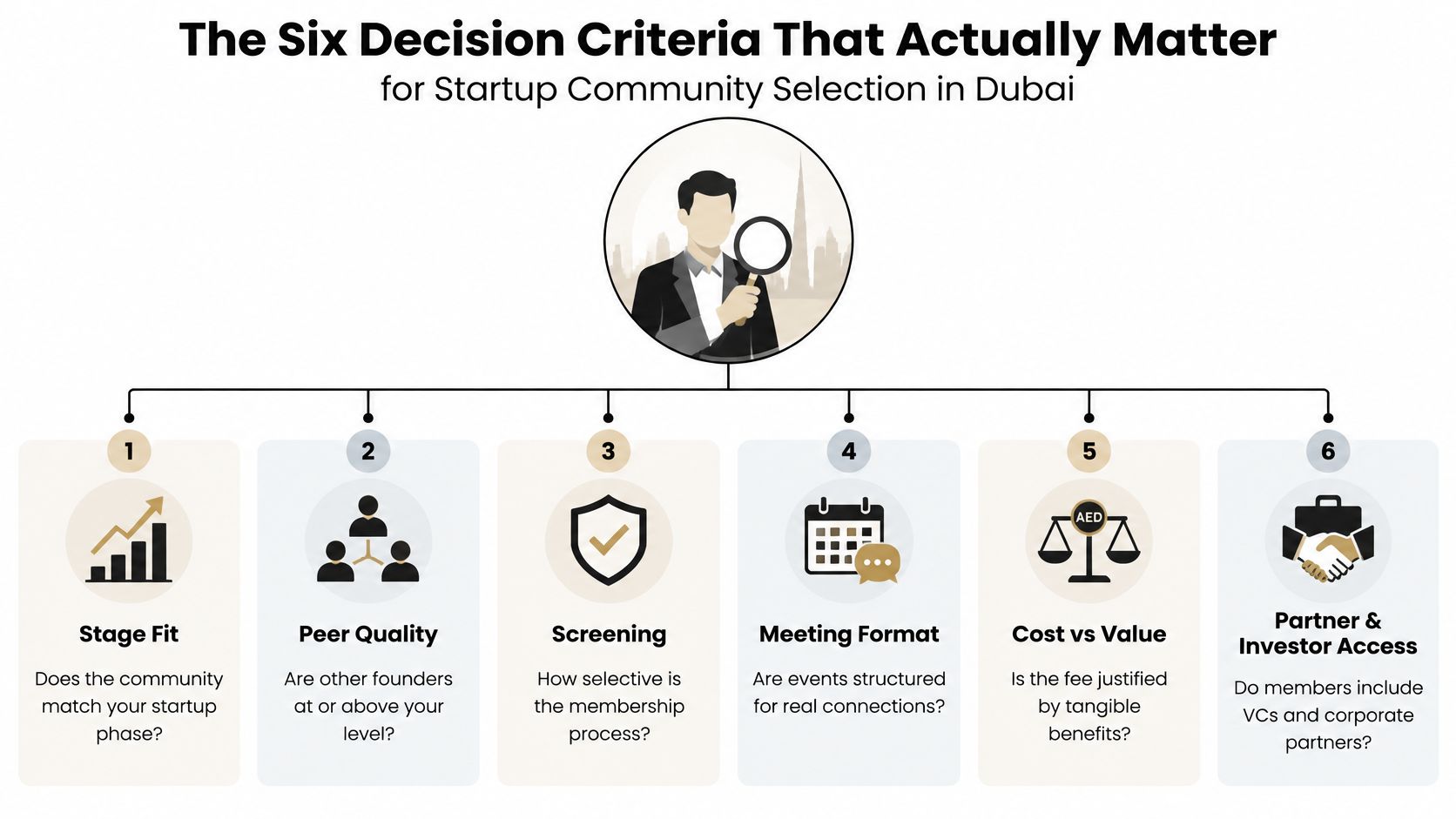
Fit and behaviour come first
- Stage fit: Look for members facing decisions close to yours. Idea validation and scaling execution require different conversations.
- Peer quality: Ask what members have built or operated. Relevant experience matters more than an impressive biography.
- Screening: Find out what the application checks and what conduct organisers expect after admission.
Dubai's international composition makes those checks important. Dubai Media Office's description of Dubai Technology Entrepreneur Campus illustrates the hub's international founder base. Cross-border experience is valuable, but verify whether members also understand the market you're entering.
Delivery determines whether you'll use it
Meeting format should give you room to participate. If you want detailed challenge and follow-through, compare the structure described in this guide to mastermind groups with an open networking format.
Cost versus value includes travel, preparation and follow-up, not just the fee. Don't count partner discounts as savings unless you'd buy those services anyway.
Partner and investor access belongs last unless it directly serves your current objective. Distinguish attendance, advice, commercial engagement and investment interest. They aren't interchangeable.
Dubai SME's account of its business support work covers advisory services, training and commercial promotion, reinforcing the importance of support beyond capital. For setup questions, use a dedicated resource such as Inpro's practical UAE company formation guidance rather than treating peer anecdotes as professional advice.
For names to shortlist, consult the Dubai founder community guide, UAE startup communities and investor networking comparison, or BNI versus founder community comparison. Use those lists for discovery, then apply your own filters.
Questions to Ask Before You Join or Pay Anything
Send the organiser your stage, sector and immediate objective before asking for a recommendation. A useful reply should explain the fit, including where the community might not suit you.
You're not asking for confidential member details. An anonymised description of participation, a clear explanation of screening and a sample session agenda should make the proposition easier to assess.
Use this checklist to keep the conversation concrete.
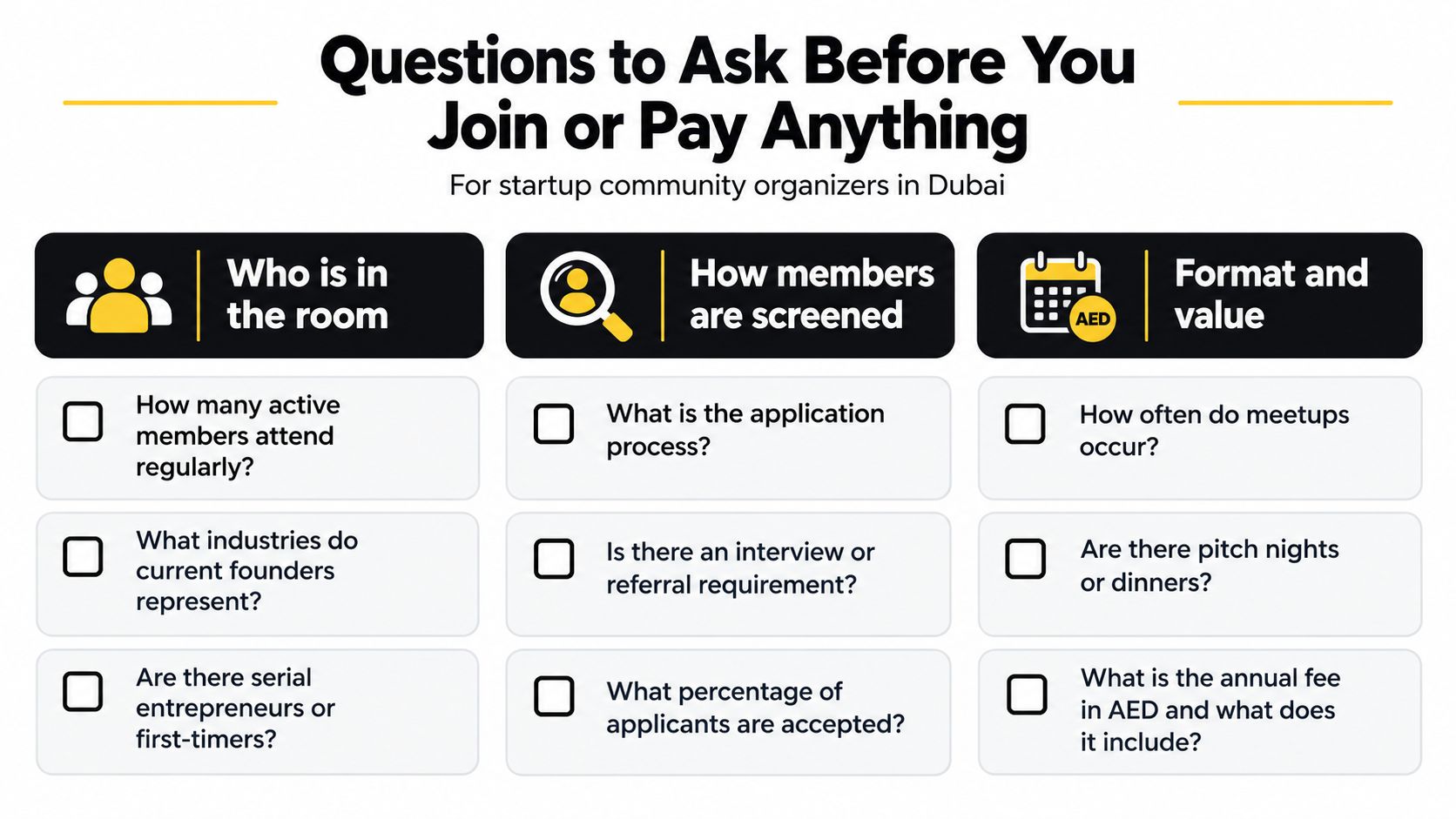
Ask the organiser about delivery
- Who's in the room: Which sectors and company stages participate regularly? Are members building companies, advising them, or selling services to them?
- How screening works: What information do applicants provide? Who reviews it? What would make an applicant unsuitable?
- Format and frequency: Can I see a recent agenda? How much time goes to discussion, pitches and open conversation?
- Cost and coverage: What's included, what costs extra, and what are the renewal and cancellation terms?
- Partner participation: What can members actually do with the advertised partners? Is participation recurring or occasional?
- Member outputs: Can you describe an anonymised example of feedback that helped a founder change a decision?
Don't assume experience follows age or job title. Dubai Chambers' Startup Panorama describes founders ranging from students and recent graduates to employees and former senior executives.
Ask which members have built or scaled a company, and which are doing it for the first time. You want relevant operating experience without assuming that first-time founders have nothing useful to contribute.
Ask a member about the experience
Speak to a current participant, with their permission, about what happens between sessions. Ask what they've used, what disappointed them and whether they feel comfortable bringing an unresolved problem.
A candid limitation is more useful than an organiser promising relevance to everyone.
If every answer returns to membership size, sponsors or the venue, you still haven't established what you're paying for.
A Simple Scoring Template You Can Use Today
Use the following as an editorial decision tool, not a published industry benchmark. Its purpose is to stop an exciting conversation from overriding evidence of poor fit.
Sector deserves its own row. Wamda's investment year review shows different funding patterns across UAE sectors. My conclusion isn't that you should join an investor-heavy group, but that a strong general reputation doesn't establish relevance to your business.
Community scoring matrix
Score each criterion from 0 to 5. Use 0 when there's no evidence, 3 for an adequate match and 5 for a strong, demonstrated match.
| Criterion | Weight | 0 to 5 score | Weighted |
|---|---|---|---|
| Stage fit | Double | Enter your score | Count score twice |
| Sector fit | Double | Enter your score | Count score twice |
| Meeting frequency and format | Standard | Enter your score | Count score once |
| Moderation quality | Double | Enter your score | Count score twice |
| Measurable member outcomes | Double | Enter your score | Count score twice |
Calculate the weighted average by adding the weighted scores and dividing by the combined weights. These weights deliberately favour relevance, discussion quality and outputs over calendar convenience.
Apply these recommended decision rules:
- Fit threshold: Reject a community scoring below 3 on either stage fit or sector fit.
- Overall threshold: Prefer options with a weighted average above 3.5.
- Evidence discipline: Record the reason beside every score. An attractive claim isn't the same as observed delivery.
- Uncertainty check: Leave unanswered questions visible rather than filling the gaps with optimism.
Compare evidence, not impressions
Consider a hypothetical founder validating a business software product. A broad room with polished speakers might offer interesting conversation but little opportunity to examine customer interviews.
A recurring discussion group might look less impressive online yet provide detailed challenge from founders selling to similar buyers. In this example, the latter deserves stronger fit and moderation scores, provided the founder observes that behaviour.
Don't invent scores before attending. Start with provisional assessments from organiser answers, then revise them after participation.
Finally, write an evidence note: What did I observe, and what remains unproven? Keep cost as a separate affordability check. A strong score doesn't make an unaffordable commitment sensible, and an inexpensive membership doesn't rescue poor fit.
Matching Meetup Formats to Your Founder Goal
Choose a format by the conversation you need to have. Don't expect a presentation audience, a dinner table and a working group to produce the same kind of participation.
The surroundings can help people relax, but they don't tell you how much useful discussion will happen.

Match the room to the work
Small recurring peer groups are my preference for idea validation and accountability. Bring a specific assumption or piece of customer evidence, rather than asking whether people like your idea.
Pitch Night Meetups suit fundraising preparation when participants can challenge the pitch. Ask whether feedback examines the business or just presentation style. Applause doesn't tell you whether your assumptions survive scrutiny.
Dinners can support longer conversations about market entry, founder decisions and regional experience. They're useful when you need context rather than a formal presentation, but check whether the format gives everyone space to participate.
Large conferences suit broad visibility and market exploration. Treat deep peer support as a separate requirement rather than expecting it from the same setting.
Independent descriptions of Dubai's startup ecosystem include recurring meetups, mixers and dinners alongside larger gatherings. The practical choice is between different modes of participation, not merely formal versus informal.
For a closer comparison of conversational settings, consult Coffee Series versus Tech After Hours. Check the actual agenda before assuming the format's name tells you how it works.
Use video as another inspection point, watching how participants engage rather than judging production quality.
Check what happens between meetings
A WhatsApp group can support follow-up, but ask whether members post specific requests, report progress and receive substantive replies. A screened group still needs clear norms.
If a longer programme appeals to you, inspect the schedule and participation expectations before paying. Don't buy a longer commitment just because you enjoyed the first conversation.
Pick the format that supports your next decision, then check whether you can participate consistently enough to benefit.
Your 14 Day Trial Plan and Next Step
Give the selection process a deadline. Otherwise, researching communities can become another way to avoid speaking to customers or making a difficult business decision.
The aim isn't to become a professional community evaluator. It's to make a defensible choice, test it and get back to building.
Begin with a written brief
Use this template:
I'm building [company type] for [customer]. My immediate decision is [specific question]. I need feedback from people with experience in [relevant work].
Save it in Notion, Google Docs or your existing founder journal. Use the same wording when contacting organisers so you can compare their responses fairly.
Then follow a compact trial process:
- Shortlist: Choose a small set of plausible communities using the matrix. Remove obvious stage or sector mismatches before booking.
- Confirm: Ask about trial participation, costs and upcoming sessions. Don't assume the calendar fits your deadline.
- Attend: Bring a live problem and, where appropriate, something people can examine, such as a pitch deck, landing page or anonymised interview notes.
- Record: Capture specific insights immediately afterwards. Separate a useful observation from a pleasant conversation.
- Act: Test the advice in your product, customer work or fundraising preparation.
- Decide: Commit where you've seen the clearest relevant value, provided the ongoing format and cost remain workable.
Judge the result after you use the advice
Write down what changed and why. Perhaps you revised an interview question, removed an unsupported pitch claim or recognised that you were targeting the wrong buyer.
Those are possible outputs, not promised outcomes. If nothing changed, determine whether the room lacked relevance or whether you arrived without a clear question.
If session dates don't align with the trial window, finish your organiser conversations and schedule the remaining test rather than paying under artificial pressure. For the relationship-building work after joining, use this guide to building a founder network in Dubai.
A community earns renewal when you can point to decisions it helped improve. If you can't identify useful value, don't renew out of habit.
Leave the trial with a decision and a next action, not another collection of invitations.
Questions Founders Ask Before Joining
Are paid memberships better than free Meetups?
Not automatically. Free Meetups can help you inspect the room without a longer financial commitment; paid membership deserves consideration when the ongoing delivery suits your needs.
Ask what you gain beyond admission. Pay for something you expect to use, not for the reassurance of belonging to an impressive group.
How do I recognise serious screening?
Look for a clear connection between the application questions and the community's purpose. An organiser should be able to explain suitability, confidentiality expectations and how they handle persistent selling or disruptive behaviour.
An application form alone proves little. The stronger test is whether members describe standards that organisers uphold.
Is WhatsApp or in-person participation better for accountability?
Ask how commitments are recorded, revisited and discussed. Either channel can be useful, but neither creates accountability just by existing.
Choose the mode you'll reliably use, then inspect the follow-up process. A busy chat you mute won't help, and neither will a recurring meeting you rarely attend.
What suggests a networking trap rather than a peer group?
Watch for conversations that repeatedly become sales pitches, vague answers about participation and pressure to pay before you understand the offer. Be cautious if organisers promote access without explaining what access means.
You should also be able to contribute without disclosing sensitive information or performing success. If you can't discuss uncertainty without immediately becoming someone's prospect, keep looking.
Founder Connects is a startup community in Dubai and the world, offering Meetups and founder experiences. If that format fits your current goal, browse the upcoming Meetups, bring a live question and use the checklist to judge the room for yourself.

Building in MENA? You don't have to do it alone.
Join 300+ founders in the Founder Connects Residency. Monthly squad calls, warm intros, $3M+ in perks, and much more. All for less than your monthly coffee budget.
Popular posts





Founder Connects is a premium MENA tech founder community. Meetups in Dubai and across MENA, Residency Squads of 8–10, and 400+ vetted WhatsApp founders (apply and screened).