

How Often Should a Founder Go to Networking Events?

Building in MENA? You don't have to do it alone.
Join 300+ founders in the Founder Connects Residency. Monthly squad calls, warm intros, $3M+ in perks, and much more. All for less than your monthly coffee budget.

A useful networking cadence leaves time to follow up between Meetups, so book the next Founder Connects Meetup only when the last conversations have a next step written down. As a flexible starting point, a founder can try one focused Meetup every two to four weeks, moving to weekly only for a defined four to eight week push and pausing for a week whenever follow-ups pile up.
The counterintuitive scheduling decision is what to leave empty. An evening without another booking gives a founder room to send the promised product note, consider difficult feedback or finish a conversation properly.
How Often Should a Founder Go to Networking Events?
There's no universal attendance target. A founder testing pricing needs a different rhythm from someone preparing a launch or working through a delivery crunch. The useful question is whether another Meetup fits the work already underway.
Consider a founder who leaves Coffee Series with feedback about an unclear offer. Booking another conversation immediately may feel productive, but revising the offer and testing the wording should come first. Otherwise, the founder risks collecting fresh opinions about an unchanged problem.
Use these scheduling rules:
- Start with breathing room. Treat a focused Meetup every two to four weeks as an adjustable starting point, not an attendance obligation.
- Write before booking. Give each promising conversation a next step before reserving another seat.
- Pause when necessary. Leave a week free when unfinished follow-ups begin accumulating.
Protect the gap
Follow-up is where founders can examine feedback, continue relationships and make decisions. The post-networking follow-up checklist gives a simple order for that work after the first conversation.
Dubai's crowded startup calendar makes selection more important than availability. Pick a format that suits the current question rather than treating every open evening as networking capacity.
Booking rule: An available seat isn't a reason to attend. A relevant goal and enough follow-up time are.
Choose the situation that matches the business, protect the planning time and change the rhythm when the work changes.
Your Networking Cadence by Stage and Goal
| Founder situation | Suggested rhythm | Best fit format | Follow-up rule |
|---|---|---|---|
| Idea stage or solo founder validating an idea | One focused Meetup every two to four weeks | Coffee Series for a focused table, or The Playbook online | Recap within 48 hours and log a next step per useful conversation |
| Preparing to pitch, fundraise or launch | Weekly for four to eight weeks before the milestone | Pitch Night & Mixer when available | Recap each useful conversation within 24 to 48 hours |
| Searching for a cofounder or key hire | Weekly for four to eight weeks before the milestone, subject to relevant availability | Cofounders Wanted | Log each promising counterpart and agree a bounded next step |
| Scaling founder steady in execution | About once a month | Tech After Hours, plus The Playbook for practical playbooks | Review open follow-ups weekly |
| Follow-ups piling up after a busy stretch | Pause new bookings for a week | None until the follow-up log is clear | Clear the backlog, then reassess the rhythm |
Read the table as planning bands
These are editorial starting points, not scientifically established attendance requirements. The GEM UAE national report provides context for treating entrepreneurial relationships as an ongoing source of information and advice, rather than an occasional promotional exercise.
Choose the row that describes the current need, not the founder's preferred identity. A scaling founder searching for a cofounder may need a temporary search rhythm. A solo founder with urgent delivery commitments may need to leave more space.
The table describes an attendee's schedule, not the publishing frequency of any particular Meetup. A weekly push doesn't mean the preferred format will run weekly. If a relevant session isn't available, continue existing conversations rather than filling the calendar with unrelated attendance.
Include the work around attendance
A Meetup occupies more than its calendar slot. Preparation, travel, recovery and the promised follow-up all compete with customer work.
Before choosing a faster band, ask:
- What needs outside input? Name the decision that cannot be resolved through desk work alone.
- What can wait? Remove attendance that serves curiosity but not the immediate priority.
- Where will follow-up happen? Reserve working time, not just the evening itself.
Use the video alongside the written plan if a visual explanation suits the planning process.
A sustainable rhythm should be easy to maintain during an ordinary working period, not only during an unusually quiet stretch. For the longer-term relationship layer, use the guide to building a founder network in Dubai.
Matching Each Meetup Format to the Current Goal
Pick the conversation before picking the date. Founder Connects is a startup community in Dubai and the world, and its Meetups are one part of building a founder network in Dubai. Its formats offer different settings, so the attendee's immediate goal should determine the choice.
Choose by the question that needs attention
Coffee Series. A small in-person table suits focused feedback and candid problem-solving. It's a sensible choice when a founder can bring a specific question, such as whether an offer explains the customer's problem clearly. Bring enough context for others to understand the issue without presenting the entire company history.
Pitch Night & Mixer. This in-person Meetup suits practising a pitch and conversations with peers and potential partners before a launch or fundraising push. Preparation should centre on what the founder wants others to understand. Attendance shouldn't be treated as a promise of access to any particular person.
Cofounders Wanted. This in-person Meetup is relevant to founders seeking a cofounder or a key hire such as a CTO, CPO, growth lead or CEO. Founders hold their own conversations about role fit. Arrive ready to discuss responsibilities, commitment and the work that needs doing, rather than relying on a job title alone.
Tech After Hours. A relaxed founder evening suits continuity and honest conversation between busy phases. It needn't become another pitch rehearsal. An attendee can arrive ready to listen, reconnect and discuss a current challenge without turning every exchange into a transaction. The guide to what to expect at tech founder Meetups in Dubai covers the evening in more detail.
The Playbook. A free online Meetup where founders share practical playbooks suits periods when travel or time limits in-person attendance. Choose it because the subject is relevant, then protect time afterwards to consider what applies to the business.
The guide to choosing a Meetup for the current stage offers another way to compare these settings.
Prepare for substance, not room time
Hub71's impact report illustrates the use of structured, individual conversations within startup support. For attendee planning, the useful principle is to favour substantive discussion over spending longer in a room.
Run a format through a complete attendance-and-follow-up cycle before stacking several formats together. Otherwise, it becomes harder to separate a poor format choice from poor preparation.
Arrive with a sentence describing the company, a current challenge and a follow-up question. For practical preparation, consult what to expect at tech founder Meetups in Dubai.
How to Build Your Networking Cadence Plan
Build the plan in a calendar and a simple contact log. A spreadsheet or notes document is enough, provided it records the conversation, the commitment and who acts next.
Use the process as a reminder to plan the work around attendance, rather than as a quota.
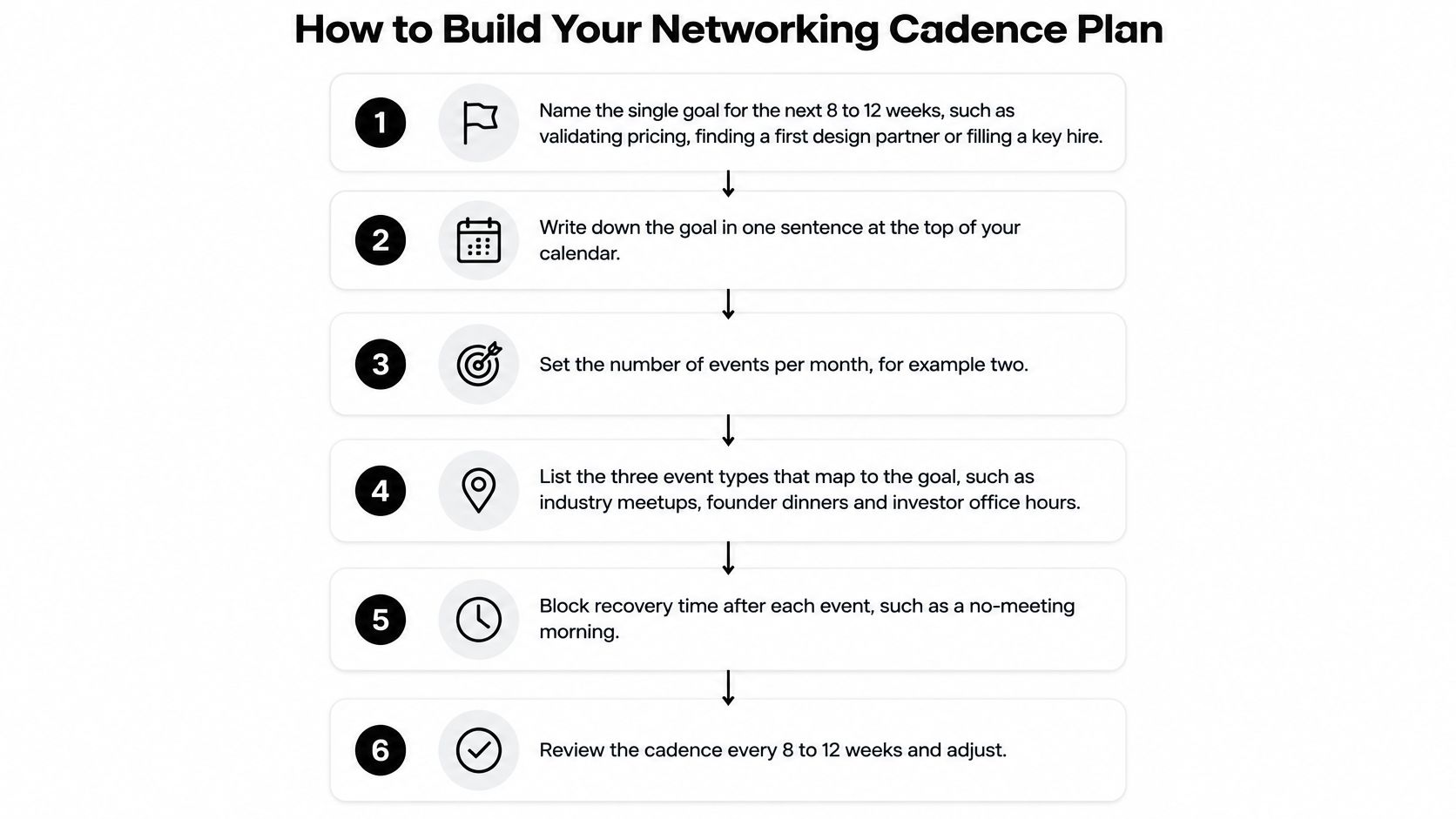
Write the plan before opening the booking page
Name the current goal. Write the decision at the top of the page. Validating pricing, assessing cofounder fit, preparing a pitch and maintaining peer accountability require different conversations. Replace a broad intention such as meeting more founders with a concrete question the founder needs to investigate.
Choose an adjustable rhythm. Select the relevant band from the table and check it against delivery commitments. Write down what would justify attending more frequently and what would trigger a pause. This prevents a temporary push from becoming a permanent calendar burden.
Select the format. Record why that setting suits the goal. A founder investigating role fit should prepare a role brief; someone seeking feedback should prepare the problem and relevant context. If there's no clear connection between the format and the question, don't book yet.
Reserve the follow-up budget. Add working time alongside the Meetup booking. Write a specific recap, request a bounded next step and sort contacts into immediate action, nurture or irrelevant to the current goal. Keep relationship notes respectful and factual. The post-networking follow-up checklist can serve as the companion template.
Apply the booking gate. Reserve the next Meetup only when every promising conversation has a written next step. That doesn't mean everyone must reply first. It means the founder has completed any immediate promise, recorded what happens next and stopped relying on memory.
Review the whole cycle. Check whether the chosen format and spacing still suit the business question. Keep what fits, change what doesn't and remove bookings made mainly from habit. A useful review can end with a decision to attend less often.
Keep the log practical
The GEM UAE national report page places entrepreneurial skills and ecosystem support within the wider UAE context. Peer advice should still be treated as something to investigate, not automatic proof that a decision is correct.
Write these fields in the log:
- Context. What was discussed, and why was it relevant?
- Commitment. What did each person agree to do?
- Next action. Who acts next, and what will they send or complete?
- Status. Is the conversation active, waiting or closed?
Record an action someone could recognise as finished. Sending a product note is actionable; keeping in touch isn't.
Protect this work using the time-management tips for startup founders. During heavy product weeks, widen the gap rather than squeezing follow-up into exhausted evenings.
For Meetups, attendees pick the Meetup, book their seat and show up. Walk-ins are turned away because room size is capped for quality, so planning also means reserving a place rather than arriving unbooked.
When to Speed Up, Slow Down or Pause
Change the schedule when the business need changes, not when more invitations arrive. The Dubai Chamber of Digital Economy's account of ecosystem activity provides context for Dubai's busy startup calendar, but availability alone shouldn't determine attendance.
Use the visual as a prompt to reconsider capacity. The practical triggers below should govern the booking decision, rather than a fixed attendance quota.
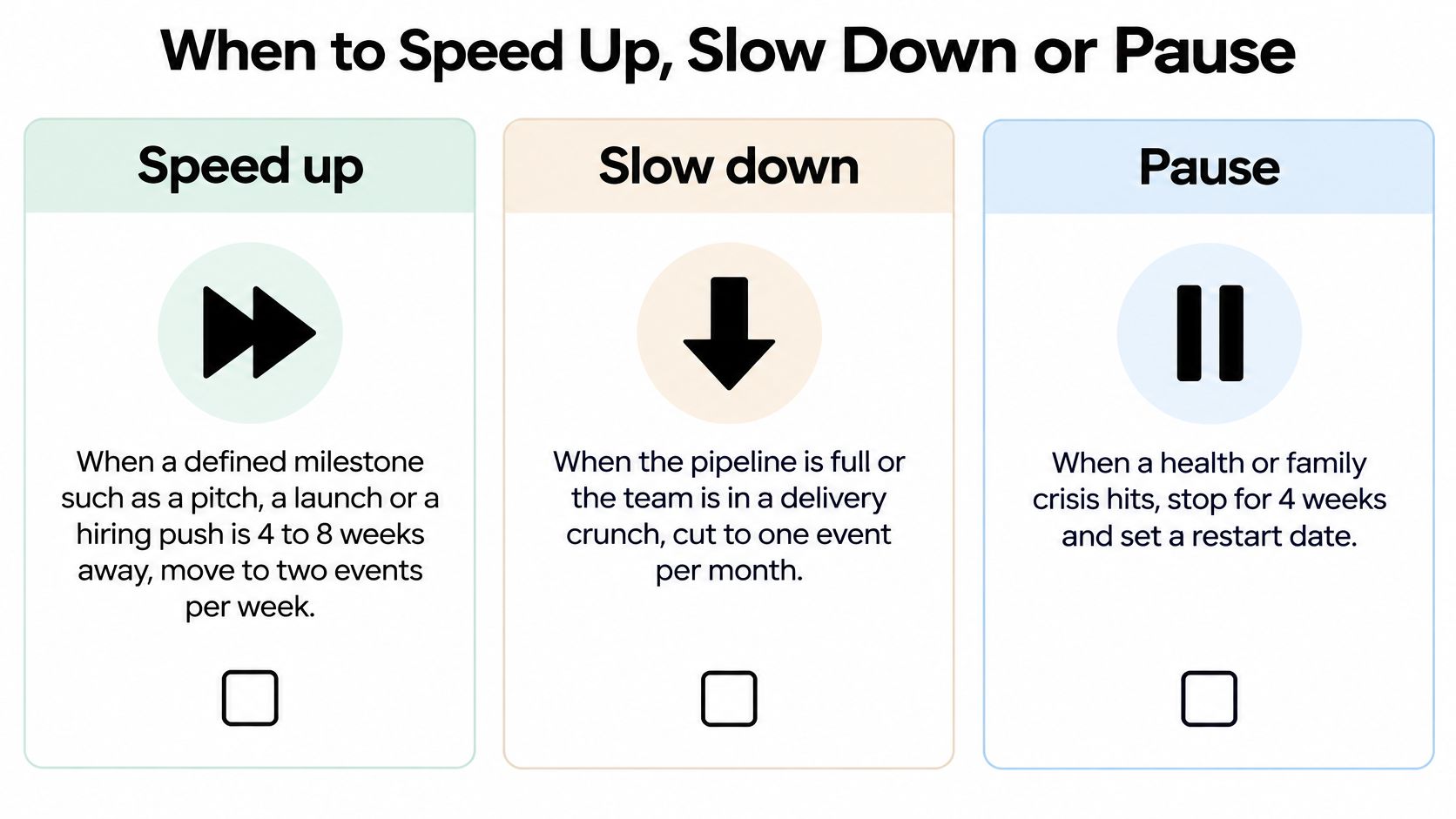
Speed up for a defined milestone
A pitch, launch or hiring push can justify a temporary increase when outside conversations are relevant to the work. Write down the milestone and the question each planned Meetup will help the founder examine.
A faster schedule needs an end condition. Once the pitch is ready, the launch work takes priority or the role requirements are clear, return to a sustainable rhythm. Don't keep attending at sprint intensity because the calendar has become familiar.
Slow down when execution needs the space
Delivery pressure changes the calculation. If attending means postponing customer conversations or missing product commitments, reduce attendance before adding more working hours.
Look for concrete warning signs:
- Unfinished promises. Useful conversations remain in notes, but promised messages haven't been sent.
- Repeated discussion. The founder keeps asking the same question without testing the advice.
- Displaced work. Travel and attendance replace customer interviews, product work or necessary recovery.
- Unclear purpose. The founder can describe the format but not why attending matters now.
Pause new bookings when these signs appear. Clear the follow-up log by completing, rescheduling or respectfully closing commitments, rather than repeatedly moving unfinished tasks forward.
Review relevance without assigning a score
Ask whether the conversations addressed the intended question and whether the founder completed the agreed actions. Don't turn attendance into a performance metric or assume every relationship needs an immediate business result.
The guide to judging whether a founder Meetup was worth attending can support that reflection.
For a solo founder, continuity may matter more than variety. Returning to a relevant setting can be a reasonable choice, provided it doesn't become a substitute for making difficult decisions independently.
Capacity check: Set the networking time the business can afford first. Choose bookings within that space, not the other way round.
Networking Cadence FAQs
Is it better to go to one founder Meetup a week or one a month?
The gap matters more than the number. Weekly attendance suits a defined push before a milestone, such as a fundraise or a cofounder search. Monthly attendance suits a founder maintaining relationships during steady execution.
A true test is what happens between Meetups. A weekly seat only earns its place when each conversation ends with a written next step, and that step is completed before the next booking. If the faster rhythm repeatedly leaves promises unfinished, the slower one is the workable choice.
What should a founder do between two networking events?
The space between events is where the value gets captured or lost. A short sequence covers it:
- Recap. Send a specific message identifying the discussion and any promised material.
- Agree a next step. Propose a bounded action and complete the founder's own commitment first.
- Classify after seven days. Mark the contact responsive or inactive without reading silence as a verdict.
- Set the next goal. Write the question the next Meetup needs to answer before booking it.
The purpose is to keep commitments visible, not to pressure another person into continuing.
How can a founder tell they are going to too many events?
The clearest signal is timing: the founder books the next Meetup while the previous follow-up log is still open. Travel and preparation start crowding out customer conversations and product work, and the same questions get asked again without the earlier advice being tested.
The practical response is to pause new bookings and resolve existing commitments: complete them, reschedule them, or close them respectfully. A quieter calendar is the right one when it restores time for the business.
Founder Connects is a startup community in Dubai and the world, built by founders for founders around honest conversations and long-term relationships. It runs in-person and online Meetups in five formats: Coffee Series, Tech After Hours, Pitch Night & Mixer, Cofounders Wanted and The Playbook, a free online Meetup.
Founders can pick their current goal, choose a matching format and book a seat through the Meetups page once their existing conversations have written next steps.
Founder Connects offers online and in-person Meetups for founders who want practical peer conversations. Pick the Meetup that fits your current goal and book your seat before your next follow-up cycle begins, so every conversation already has a next step waiting for it.

Building in MENA? You don't have to do it alone.
Join 300+ founders in the Founder Connects Residency. Monthly squad calls, warm intros, $3M+ in perks, and much more. All for less than your monthly coffee budget.
Popular posts





Founder Connects is a premium tech founder community in Dubai and the world. Meetups, Residency Squads of 8–10, and a WhatsApp group of 600+ vetted founders.