

8 Time Management Tips for Startup Founders in 2026

Building in MENA? You don't have to do it alone.
Join 300+ founders in the Founder Connects Residency. Monthly squad calls, warm intros, $3M+ in perks, and much more. All for less than your monthly coffee budget.

It's 8 PM on a Tuesday in Dubai. You've been on back-to-back calls since 9 AM, your team is waiting on decisions, and the investor deck is still half-finished. That isn't a scaling rhythm, it's a calendar problem, and in the UAE and wider MENA context, founders feel it fast because execution speed matters and interruptions never really stop.
The fix isn't working harder. It's building a founder operating system that protects deep work, forces decisions into the right channels, and makes your schedule match the business you're trying to build. The best time management tips for startup founders aren't isolated tricks, they work together, and they have to fit the reality of investor calls, team syncs, sales pressure, and regional working patterns.
1. Calendar Blocking Protects Deep Work Before Meetings Take Over
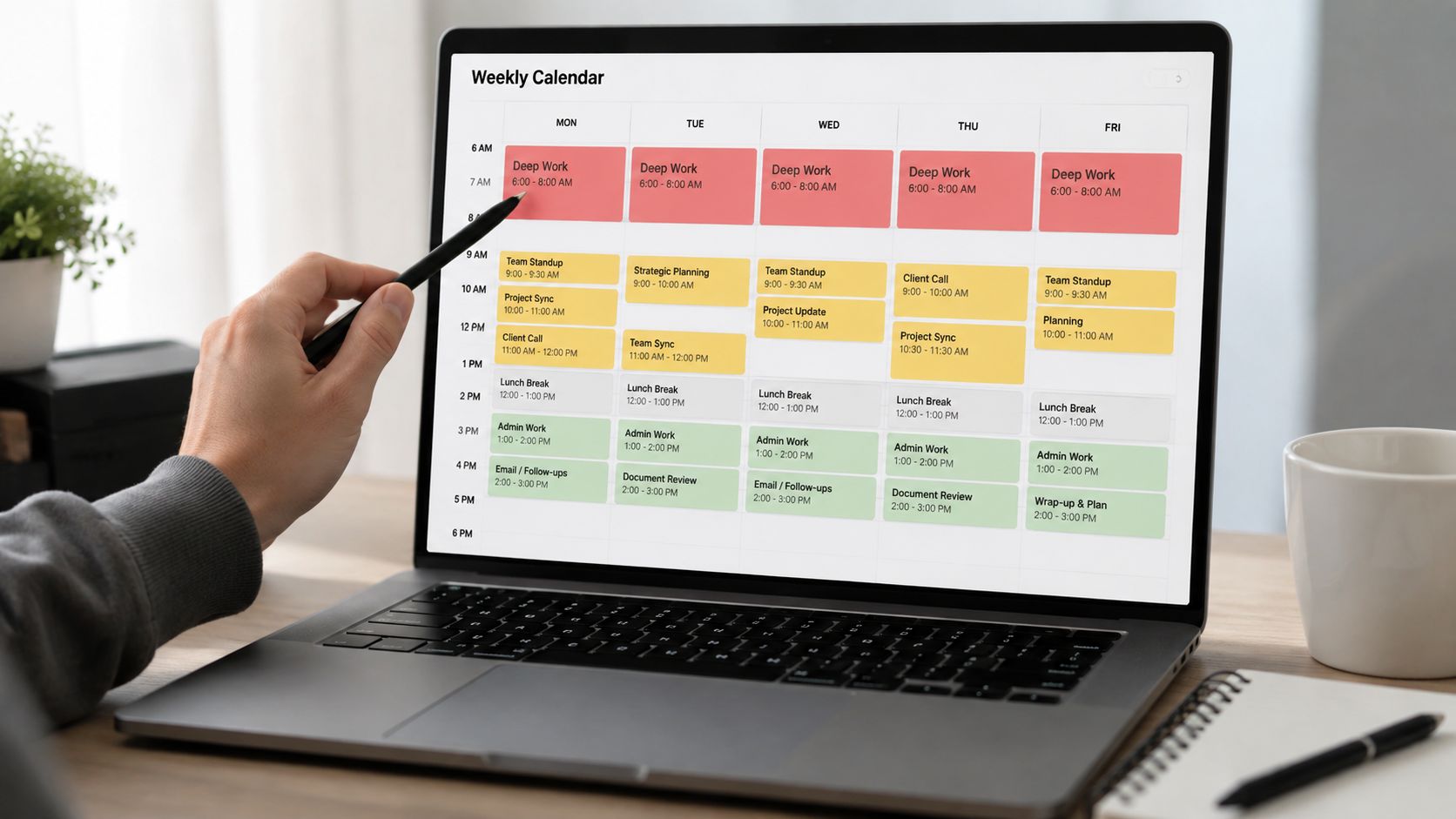
If your calendar is open, other people will fill it. That's the default in most startups, and it's especially costly in the UAE and MENA where founders juggle fundraising, hiring, product, and stakeholder management at the same time. The practical fix is to block your week around execution first, then let meetings fit around those blocks.
Practical rule: Put your highest-value work on the calendar before anyone else gets a chance to book it.
Use deep work blocks for tasks that move the company forward, such as product decisions, fundraising narrative, pricing, and strategic writing. Keep them visible as busy on shared calendars, and use Google Calendar or Outlook focus features so invites can't slip through the cracks. If you're new to this, start with three protected blocks per week, then build from there.
A good UAE founder rhythm often looks like this. Monday and Wednesday mornings stay open for product and strategy, while Tuesday and Thursday absorb investor calls, team 1-on-1s, and external conversations. A VC-backed founder in the region can keep one afternoon reserved for investor updates instead of letting those meetings scatter across the entire week.
The discipline matters because founder time gets swallowed by low-value work quickly. Research summaries indicate entrepreneurs spend about 16 to 20 hours per week on admin work, and email alone can take roughly 2.6 hours per day, or more than 12 hours per week. The same research set says time audits often reveal 12 to 22 hours per week of non-founder-essential work, which means the cost of an unprotected calendar is huge. See the founder time research summary on administrative time loss and delegation patterns for the underlying pattern.
A simple way to start this week:
- Block morning hours first: Most founders do their sharpest thinking early, so use that window for hard work.
- Mark deep work as busy: Don't leave it as a soft suggestion.
- Review Sunday night: Check that nothing has slipped into your protected slots.
- Audit last week: If deep work was underweight, add five two-hour blocks next week.
2. Meeting Batching Keeps Your Week From Fragmenting
Founders rarely lose time in one dramatic way. They lose it in dozens of small interruptions, one call here, one check-in there, one “quick sync” that turns into a reset of the whole afternoon. Meeting batching solves that by clustering conversations into a few designated days and leaving the rest of the week open for real work.
For an early-stage founder in Abu Dhabi, that might mean external meetings live on Monday and Tuesday, then Wednesday to Friday stay clear for execution. A Series A founder in Dubai can batch investor updates and board prep into one afternoon block, which keeps the rest of the week available for product, hiring, and operating decisions. The point is simple, if a meeting doesn't need to happen today, it probably shouldn't spread across the entire week.
This fits the regional reality well. In the UAE and broader MENA ecosystem, founders are often managing many stakeholder conversations at once, and that makes calendar control a strategic tool, not a preference. Aggregated founder-time research reports that 68.1% of working hours are spent on tasks inside the business, while only 31.9% goes to strategy and growth, and the same source says about one-third of the workweek can vanish into meetings, with at least half of those meetings producing no meaningful output. The research summary on founder time allocation and meeting load shows why batching matters.
Use batching with guardrails:
- Choose two meeting days first: Keep three days as clear as possible.
- Group similar calls together: Put all 1-on-1s in one block, all external calls in another.
- Leave buffers: Fifteen to 30 minutes between calls gives you time to reset.
- Use async when possible: A Loom update often beats a meeting for status reporting.
- Tell the team early: If people know your meeting days, they stop trying to sneak calls into your deep work windows.
This is what a founder's week should feel like, not constant availability, but intentional access. When the calendar is predictable, the company gets better decisions faster, and you stop paying the context-switching tax all day.
3. Delegation Rules Stop You Becoming the Approval Layer
A lot of founder time disappears because the team doesn't know what it can decide without asking. That's not a people problem, it's a systems problem. If every choice runs through you, you become the bottleneck for hiring, spending, product, and even routine communication.
A delegation matrix solves this by setting clear decision rights. Write down which decisions the team can make alone, which ones need a quick consultation, and which ones need your sign-off. Keep it simple, use three tiers, and start with the decisions that hit your calendar most often, hiring, spend, partnerships, product tweaks, and customer communication.
The best version isn't theoretical. A B2B SaaS founder might let product lead make UI and UX changes solo, but require consultation on roadmap shifts and founder approval for pivots. An e-commerce founder might let operations approve vendor contracts below a certain threshold, while bigger commitments move up. The exact categories vary, but the logic stays the same, less founder friction, faster execution.
Practical rule: If you're reviewing the same type of decision more than once, the team probably needs authority, not another check-in.
Document the rules in Google Docs or Notion, then review them in monthly 1-on-1s. Ask the direct question, “Are you escalating decisions that you should own?” That one question often reveals where the drag is. It also creates a clean feedback loop, so when delegated decisions go badly, the team learns instead of waiting for you to rescue everything.
For a useful deeper read on how strong teams operate around founder decision-making, see how UAE founders built strong teams. The lesson that matters here is that delegation isn't abdication, it's a way to keep founder time on the decisions only the founder can make.
A workable first step:
- List your last 10 decisions: Mark which ones could have been owned by someone else.
- Create three tiers: Solo decision, consult, founder approval.
- Test for two weeks: Let the team use the matrix, then tighten only where needed.
- Reward good judgement: Delegation works better when people see that ownership is valued.
4. Deep Work Hours Should Be Non-Negotiable Before 11am
If your morning gets consumed by messages, you've already lost the best part of the day. Deep work is the part of the schedule where you think clearly enough to write the pitch, decide on product direction, work through unit economics, or solve a technical problem without switching context every few minutes. For founders, this is where the greatest impact happens.
The most useful pattern is to protect a 2 to 4 hour block before 11am. If that sounds impossible, start with 90 minutes and build up. The goal is to make hard thinking a normal part of your operating rhythm, not something you squeeze in after the inbox has already taken over.
A Dubai fintech founder might reserve 6:30am to 9:30am for product strategy and technical decisions. A Cairo SaaS founder can use 7am to 10am for fundraising narrative and investor materials, then move into calls later. A founder running e-commerce in the region can use early mornings for unit economics and strategy while the rest of the day handles operational noise.
There's a practical reason to defend this block. A founder time-management guide recommends placing high-focus work in peak energy hours, usually mornings, and scheduling two to three deep-focus blocks per day when possible. It also recommends a time audit over three days to two weeks so you can see where the leaks are, then eliminate, delegate, or automate the low-value items. The startup time audit and deep-focus framework is useful because it treats focus as a schedule design problem, not a motivation problem.
A good morning stack looks like this:
- Prepare the night before: Decide the one high-cognition task in advance.
- Use a timer: A 50-minute focus and 10-minute break rhythm can help you sustain attention.
- Block distractions: Website blockers like Freedom or Cold Turkey reduce accidental drift.
- Protect the first hour: Don't open email before the hardest work.

The core trade-off is simple. If you don't protect this time, the day will still happen, just without your highest-value thinking in it.
5. Tool Stack Simplification Cuts Context Switching
Too many founders use software like they're collecting tools, not building an operating system. The result is obvious, notifications everywhere, duplicated work, and no one is sure where the truth lives. A lean stack is faster because it reduces switching costs and makes your team easier to onboard.
Keep your core tools to 5 to 7 if you can. Choose the systems that run the business, usually one calendar, one task manager, one communication tool, one document hub, one CRM or customer tool, and one finance or analytics layer. If a tool doesn't have a clear job, it's probably causing more friction than it removes.
An early-stage SaaS founder can often consolidate around Linear, Notion, and Google Sheets. A MENA marketplace founder might standardise on Slack and cut duplicate chat tools. A scaling fintech team may simplify the analytics stack so data doesn't split across too many places. The point isn't minimalism for its own sake, it's cleaner decisions and fewer places to look when something breaks.
Cisco's 2025 SMB Digital Maturity Index for the UAE found that 69% of SMEs already use digital management tools, 52% have adopted AI tools, and 96% reported a positive impact from digital transformation. That matters because local adoption is already broad enough to support structured workflows, not just ad hoc productivity hacks. The data is available in Cisco's UAE SMB digital maturity coverage, accessible through the UAE SMB digital maturity presentation.
A practical founder rule set:
- One-in, one-out: If you add a tool, remove one.
- Audit monthly: Check last use date, owner, and cost.
- Prefer integrations: Tools that connect through APIs or Zapier save manual work.
- Write a reason for each core tool: If nobody can explain why it exists, cut it.
For founder-friendly tool ideas and stack choices, the top tools for founder time management guide is worth a look. Use it to sharpen the stack, not to add another layer of software.
6. The No Meeting Before 10am Rule Protects Your Maker Time
Some founders need a hard boundary, not a softer calendar habit. A no meeting before 10am rule gives you a clear line between maker time and manager time, and it stops the day from being hijacked before you've done any real thinking.
This rule works because mornings are usually the cleanest stretch of the day. Email hasn't exploded yet, Slack is quieter, and you still have enough mental runway to do something hard. If you let a call start at 8:30am, you often pay for it until lunch because the interruption reshapes the whole morning.
A founder in Tel Aviv can tell investors they block 6am to 10am daily and are available after that. A Dubai founder can use the same boundary during fundraising and frame it as a way to improve conversation quality. A Beirut pre-seed founder might reserve 6am to 9am for writing and investor materials, then open the calendar later. The rule is the same, but the shape can flex if you're not a morning person.
The key is communication. Tell your board, investors, and team that this boundary protects focus time and makes your meetings better. In early fundraising, you may need to break it on two or three days a week for investor calls, but don't turn that into a habit. Exceptions become the new normal faster than founders expect.
Protect the first 30 days like it's a product launch. If you keep the boundary long enough, people stop testing it.
Use your calendar tool's focus-time settings, and put the block on shared calendars so it's visible. If you work better in the afternoon, shift the rule instead, maybe no meetings from 2pm to 6pm. The exact hours matter less than the discipline of having a protected window that nobody casually books over.
A practical next move is simple. Set the rule tomorrow, tell your top contacts, and hold the boundary for a month before judging it.
7. Weekly Review And Planning Keeps You From Drifting
A founder's calendar can look full and still be badly misaligned. The weekly review fixes that by forcing a short reset before the next week starts. It doesn't need to be long, 20 to 30 minutes is enough if you keep it disciplined.
Use Sunday evening or Friday afternoon and make it a fixed habit. Review what happened, check whether your actual time matched your priorities, then set the top three outcomes for the coming week. If you're a co-founder team, do it together once a week so you don't drift into parallel agendas.
The best version is simple enough to repeat without thinking:
- Past week: Wins, misses, and what you learned.
- Goals alignment: Are you still on track?
- Next week: Top three priorities and the blocks that protect them.
A pre-seed founder in Amman can use this ritual to align the week with fundraising timelines. A Series A founder in Dubai can spot misalignment early and rebalance investor work against product work. A solo founder in Cairo can use a short Friday review and then sync with a remote co-founder for alignment. These are small moves, but they prevent the week from turning into reactive drift.
For a useful mental health companion to this habit, the founder mental wellness checklist is a good complement, because founders usually need both schedule discipline and emotional clarity. A clean calendar helps, but a weekly reset helps you notice when the pace itself is becoming a problem.
One useful metric makes the ritual stronger. Track hours spent on deep work versus meetings, then compare that to your stated priorities. If the numbers don't match, the week probably doesn't either. Keep it lightweight, though, because this is about clarity, not another chore.
8. Time Audit And Tracking Show You Where The Hours Actually Go
Founders are usually wrong about where their time goes. Not wildly wrong, just wrong enough to keep repeating the same mistakes. A monthly time audit makes the gap between intention and reality visible, which is the only way to fix it.
Track your time for one to two weeks each month, or at least do spot checks quarterly if full tracking feels heavy. Use categories that matter to your business, deep work, meetings, email and admin, fundraising, team, sales, and other. Then review the data on Friday afternoon and look for the parts of the week that don't line up with your stated priorities.
Passive tools like Toggl and RescueTime help because they log activity without relying on memory. Manual tracking works too if you're disciplined about it. The point is not perfect measurement, it's honest measurement.
A founder running a Series A company might discover they're spending less product time than they thought, then protect morning focus blocks immediately. A pre-seed founder in Riyadh can cut low-impact tasks after a one-week audit and reclaim time for fundraising. A scaling founder may realise team management has ballooned and decide it's time to add a COO so founder time can move back toward strategy.
For an additional visual guide, this short time well spent founder exercise video is useful if you want a simple way to think about where the week goes.
The audit isn't there to judge you. It's there to show you where your calendar is lying.
Use the audit to justify actual changes, not just to collect more data. Reduce recurring meetings, enforce batching, and delegate tasks that consume a lot of time but little strategic value. If the audit keeps showing the same leakage, the problem isn't awareness anymore, it's enforcement.
A clean monthly routine is enough:
- Track for a short window: One to two weeks.
- Review the split: Compare actual time to desired time.
- Change one thing: Don't try to fix everything at once.
- Recheck next month: See whether the change held.
Startup Founders: 8-Point Time Management Comparison
| Practice | Core features | Effectiveness (★) | Value / ROI (💰) | Best for (👥) | Unique benefit (✨) |
|---|---|---|---|---|---|
| Calendar Blocking: Protect Deep Work Hours | Pre-scheduled color-coded blocks, buffers, recurring rhythm | ★★★★ | High 💰 | 👥 Founders needing predictable execution + meetings | ✨ Predictable protected focus windows; reduces reactive scheduling |
| Meeting Batching: Cluster Meetings into 2–3 Days | 1–3 meeting days, back-to-back clusters, async on clear days | ★★★★★ 🏆 | High 💰 | 👥 Scaling founders, investor-heavy roles, cross-team leads | ✨ Long uninterrupted blocks for deep projects and prep efficiency |
| Delegation Rules: Decision Authority Matrix | Role-tied matrix, 3 tiers (solo/consult/escalate), spending thresholds | ★★★★★ 🏆 | High 💰 | 👥 Founders building teams / hiring managers | ✨ Removes bottlenecks, speeds decisions and builds ownership |
| Deep Work Hours: 2–4hr Morning Blocks | Non-negotiable morning blocks, zero notifications, pre-planned tasks | ★★★★★ 🏆 | High 💰 | 👥 Makers, product founders, pitch writers | ✨ Highest-cognition output; improves strategy & pitch quality |
| Tool Stack Simplification: 5–7 Core Tools Max | Criteria-based core tools, integrations, quarterly audits | ★★★★ | High 💰 | 👥 Early-stage teams, small ops, cost-conscious founders | ✨ Cuts context-switching & costs; simplifies onboarding |
| "No Meeting Before 10am" Rule | Calendar block 6–10am, strict exceptions, shared boundary | ★★★★ | Medium 💰 | 👥 Founders who peak mornings; teams needing clear boundary | ✨ Easy-to-communicate maker boundary that preserves mornings |
| Weekly Review & Planning Ritual (Sun eve) | 20–30min template: reflect, align, plan + calendar check | ★★★ | Medium 💰 | 👥 Solo founders, co-founders, small leadership teams | ✨ Weekly reset that prevents drift and clarifies priorities |
| Time Audit & Tracking: Monthly Accounting | 1–2 week monthly audit, 5–7 categories, tools (Toggl/RescueTime) | ★★★★ | High 💰 | 👥 Founders who feel busy but unproductive | ✨ Data-driven visibility to reallocate time and justify changes |
From Busy Founder to Effective CEO
These aren't separate productivity hacks. They're parts of one operating system. Calendar blocking protects your best hours, meeting batching keeps the week from fragmenting, delegation rules stop you from becoming the approval layer, and deep work hours make sure the hard thinking happens before the day gets away from you.
The other pieces matter just as much. A lean tool stack reduces switching costs, a no-meeting-before-10am rule protects maker time, a weekly review keeps priorities honest, and a monthly time audit shows whether your schedule matches reality. Used together, these habits turn founder time from a leak into a lever.
The trade-off is clear. If you keep treating time as something that gets used up by whoever asks first, your company will keep pulling you into reactive work. If you treat time like the operating asset it is, you can spend more of it on the decisions that change revenue, hiring, product quality, and investor outcomes. In the UAE and MENA context, that matters even more because local working patterns, fast execution, and constant stakeholder pressure make sloppy scheduling expensive.
You do not need to implement all eight ideas this week. Pick one, time blocking or the weekly review are the easiest starting points, and make it a firm priority. Then add the next one only after the first is stable. That's how founder systems stick.
If you want peer accountability while you build that system, a curated founder community can help. Founder Connects is built for founders who want practical support, meaningful peer groups, and relevant introductions in the UAE and wider MENA ecosystem, which makes it a sensible place to pressure-test how you run your week.
If you want founder-to-founder accountability on time management, join a community that's built around real execution, not empty networking. Founder Connects gives UAE and MENA founders a place to compare operating systems, swap practical tactics, and stay on track with people who understand the pressure of building.

Building in MENA? You don't have to do it alone.
Join 300+ founders in the Founder Connects Residency. Monthly squad calls, warm intros, $3M+ in perks, and much more. All for less than your monthly coffee budget.
Popular posts





Founder Connects is a premium MENA tech founder community. Meetups in Dubai and across MENA, Residency Squads of 8–10, and 400+ vetted WhatsApp founders (apply and screened).