

Hub71+ Life Sciences Opens Biotech Paths
Building in MENA? You don't have to do it alone.
Join 300+ founders in the Founder Connects Residency. Monthly squad calls, warm intros, $3M+ in perks, and much more. All for less than your monthly coffee budget.

If I had to sum this up in one line: Hub71+ looks like the best fit for biotech teams among UAE accelerators and incubators that need regulatory testing, research links, and investor access in one place.
Here’s the short version:
- Hub71+ Life Sciences suits startups moving towards launch, with 3 tracks: Initiate, Access, and Sandbox.
- HealthX by startAD is harder to assess because the public detail in the source set is thin.
- SAIA at SRTIP looks less suited to biotech teams that need labs or a clear path with regulators.
- Masdar City Life Sciences Cluster fits teams that are still deep in R&D and need lab space first.
- Dubai Science Park fits companies moving from research into commercial launch.
- Dubai Healthcare City with MBRU is a better match for teams that need close contact with clinics, hospitals, and ethics boards.
The article compares these options using 4 checks:
- Lab access
- Regulatory validation
- Mentor support
- Investor reach
One detail stands out: Hub71+ includes a 12-month Access track and a Sandbox route for supervised testing before launch. But there is a trade-off: at least one founder must relocate to Abu Dhabi.
Quick Comparison
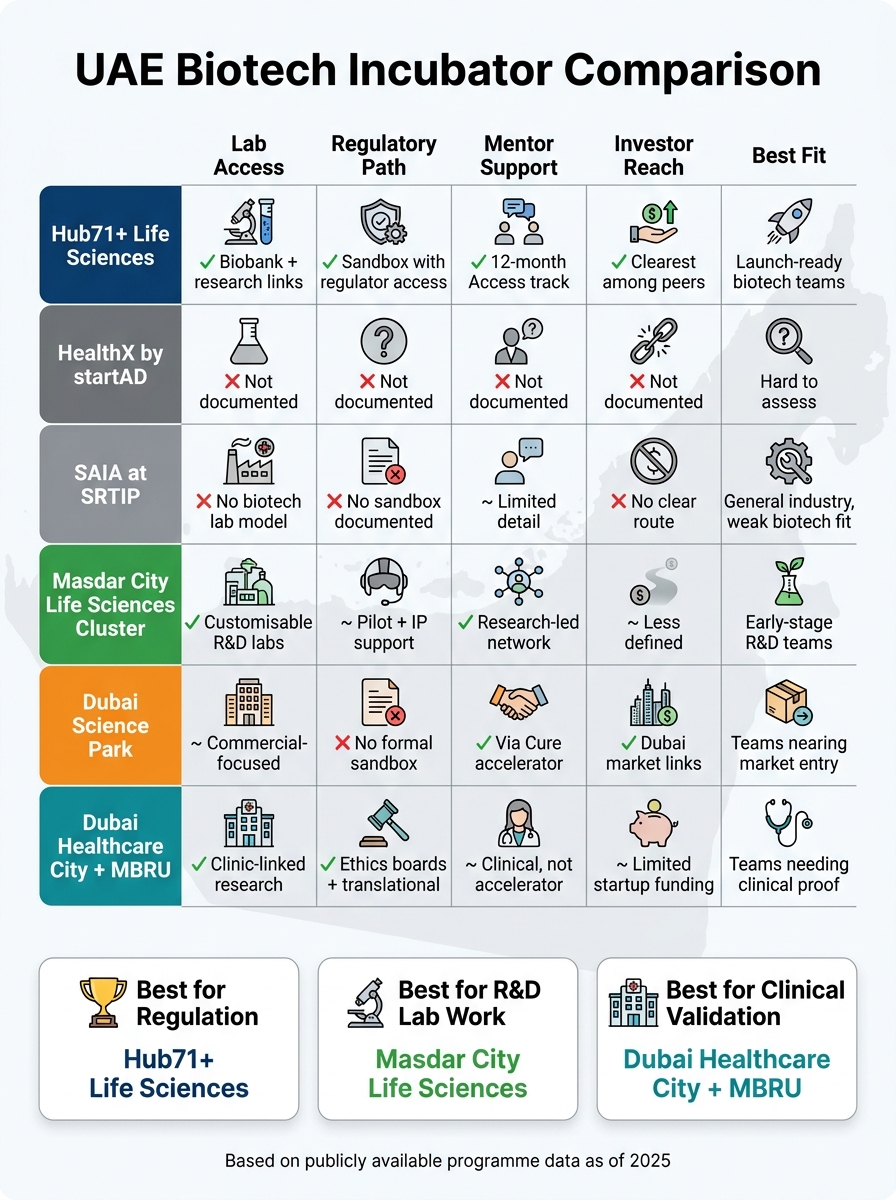
UAE Biotech Incubators Compared: Hub71+, Masdar, DHCC & More
| Programme | Lab access | Regulatory path | Mentor support | Investor reach | Best fit |
|---|---|---|---|---|---|
| Hub71+ Life Sciences | Research and biobank links | Sandbox with regulator access | Yes, through Access | Clearer than most peers | Launch-ready biotech teams |
| HealthX by startAD | Not clearly set out in sources | Not clearly set out in sources | Not clearly set out in sources | Not clearly set out in sources | Hard to place from available material |
| SAIA at SRTIP | No clear biotech lab model in sources | No clear sandbox in sources | Limited public detail | No clear route in sources | General industry support, less direct for biotech |
| Masdar City Life Sciences | Strong lab and R&D setup | Pilot and approval support | Research-led network | Less clearly defined | Early-stage R&D teams |
| Dubai Science Park | More commercial than lab-deep | No formal sandbox noted | Via accelerator support | Good Dubai market links | Teams nearing market entry |
| Dubai Healthcare City + MBRU | Clinic-linked research access | Good for translational and ethics-linked work | More clinical than accelerator-led | Less broad startup funding support | Teams needing clinical proof |
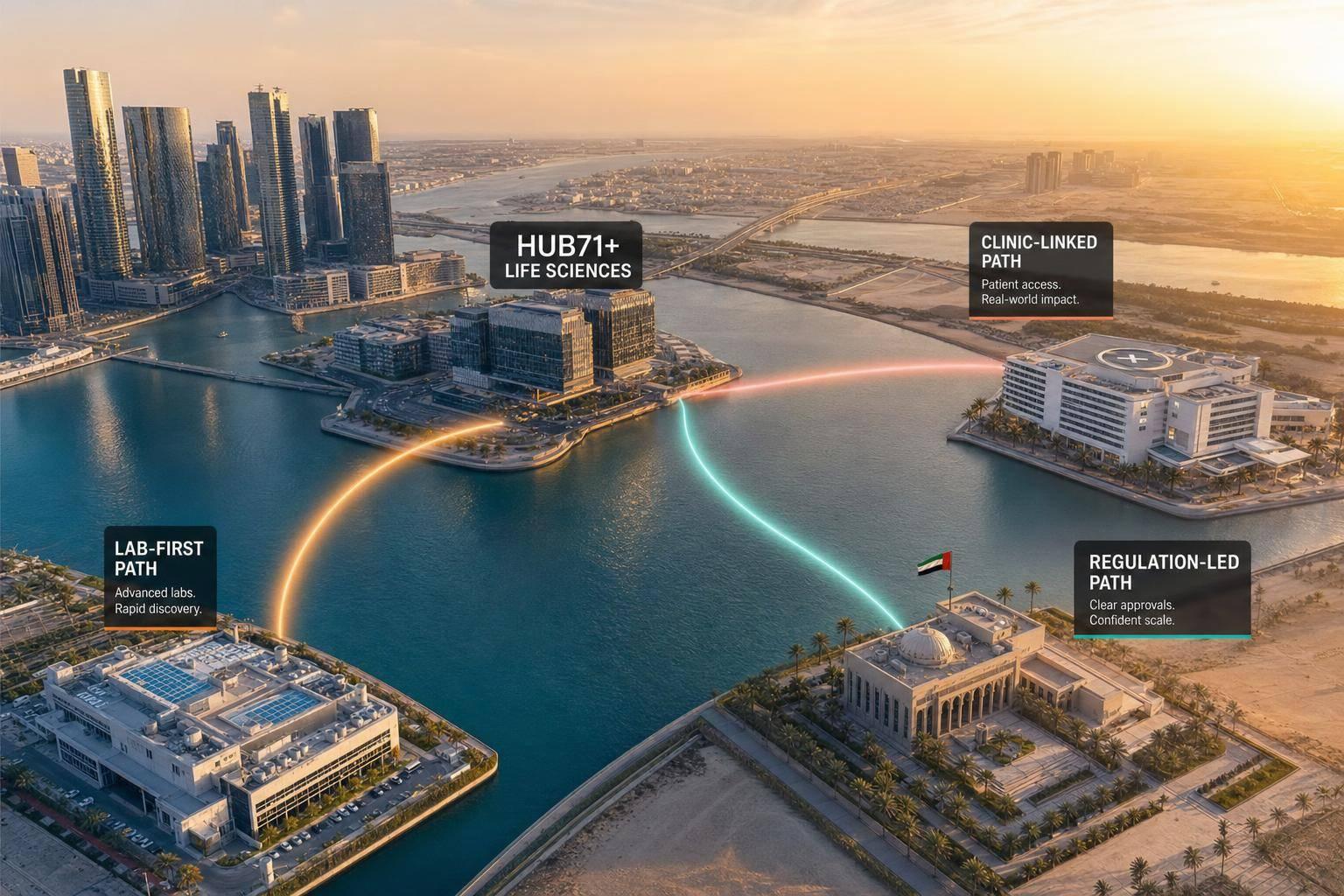
If you’re deciding where to build, the choice is simple: pick Hub71+ for regulation-led growth, Masdar for lab-first work, and DHCC for clinic-led validation. The rest of the article breaks down where each model sits and how they compare to other top incubators and accelerators in the UAE.
sbb-itb-f597d8f
1. Hub71+ Life Sciences
Hub71+ Life Sciences is a focused platform for biotech, MedTech, and digital health startups. It runs across three tracks: Initiate, Access, and Sandbox.
Lab Access
BioTwin’s July 2026 partnership with the Abu Dhabi Biobank shows how Hub71+ can connect startups with local biological data and research infrastructure.[1]
That kind of access matters most when it moves beyond research and into validation and investor readiness.
Clinical and Regulatory Links
Sandbox is Hub71+’s clearest point of difference. It gives launch-ready startups a structured path to the Department of Health and other regulators, with controlled real-world testing before launch.
Mentor Network and Capital
Hub71+ also helps cut early operating costs for founders moving to the Abu Dhabi startup ecosystem. The 12-month Access track links founders with mentors, corporate partners, researchers, and healthcare stakeholders. SAFE notes and in-kind support, including office space, housing, and health insurance, also lower setup costs.
There’s one clear condition: at least one founder must relocate and help build the local team.
That makes Hub71+ a strong fit for teams that want research access, regulatory validation, and capital in one place.
2. HealthX by startAD
Compared with Hub71+ Life Sciences’ defined biotech pathway, HealthX is harder to judge on the same terms. The available sources offer limited verifiable detail on HealthX by startAD, which makes its biotech fit tougher to assess across the same criteria used for Hub71+ Life Sciences: lab access, regulatory testing, mentor support, and access to capital.
Lab Access
The sources do not define a HealthX lab-access model.
Clinical and Regulatory Links
The sources do not describe a clear HealthX regulatory pathway.
Mentor Network and Investor Reach
The provided sources do not specify HealthX’s mentor or funding support.
That lack of documentation makes HealthX harder to place within the biotech stack than Hub71+ Life Sciences. It becomes a bigger issue when HealthX is compared with UAE incubators and accelerators that show clearer lab, mentor, and capital access.
3. Sharjah Advanced Industry Accelerator (SAIA) at SRTIP
SAIA is not framed here as a biotech incubator. So, compared with Hub71+ Life Sciences, the fit is weaker in a few areas that matter a lot to biotech founders: research access, regulation, mentorship, and capital.
The fairest comparison is about structure, not depth of support. SAIA sits further away from the biotech research stack than Hub71+ Life Sciences, which makes it a less direct option for teams building in regulated health or research-heavy fields.
Lab Access
SAIA does not set out a biotech lab model in the material provided. Hub71+ Life Sciences does, with specialised biotech support and access to research infrastructure.
That gap matters. If a founder needs active research infrastructure, not just general industrial acceleration, SAIA is harder to place as a strong match.
Regulatory Pathway
SAIA has no documented regulatory sandbox or clinical testing route. For regulated health startups, that means there is no documented sandbox in the material available.
Hub71+ Life Sciences, by contrast, offers a Sandbox programme for launch-ready startups to engage with regulators and conduct real-world testing before commercial deployment. [1]
Mentor Network and Investor Reach
SAIA’s mentor network and funding channels for biotech teams are not clearly set out. For founders looking for funding, that means there is no clear pitch route for UAE angel investors based on the material provided.
Its investor reach also cannot be assessed from the same material. The next models make that support more concrete.
4. Masdar City Life Sciences Cluster and Biosphere Labs
Masdar City is a lab-led research district built for biotech teams that spend most of their time in R&D. In plain terms, it suits companies that are still deep in research more than startups focused on launch and scale.
Lab Access
The Life Science Innovation Hub at Masdar City offers customisable labs for R&D and clinical research. It also supports data-heavy biotech work, including genomic sequencing and health informatics. [2]
Masdar City also gives startups licensing options and office setups that are easier to work with in the early stages. [2] That matters when a team is moving fast, testing ideas, and shifting from bench work into pilot testing.
Clinical and Regulatory Links
Because Masdar City is in Abu Dhabi, startups are close to healthcare providers and national medical research centres. That kind of access can make early testing and collaboration much easier.
Regulatory support includes help with intellectual property (IP) protection and approval processes. The ecosystem also supports pilot programmes and controlled testbeds for health solutions, similar to the best incubators and accelerators for MVP development. [2] Compared with Hub71+'s regulator-facing Sandbox, Masdar is stronger at early R&D and pilot testing. [1] So the model here is research-first, not built mainly for market entry.
Mentor Network and Investor Reach
The mentoring setup at Masdar leans more toward research depth than direct fundraising. Startups can tap into a network of industry veterans and academic experts, including nearby institutions such as Khalifa University and the Mohamed bin Zayed University of Artificial Intelligence (MBZUAI). [2]
That said, Masdar puts more weight on research collaboration and testbeds than on a clear investor path. For founders, that makes a difference: if your next step is lab work and validation, the fit is strong. If your main goal is investor access, you may need to explore the best seed funding options elsewhere.
5. Dubai Science Park
After research-first hubs like Hub71+ and Masdar, Dubai Science Park is a better fit for founders who are closer to market. It is Dubai’s commercialisation-focused life sciences hub, built for biotech teams moving from R&D into market entry.
Lab Access
Dubai Science Park works well for founders who need a Dubai base and direct industry access, more than deep research infrastructure.
Clinical and Regulatory Links
Dubai Science Park is not a regulatory sandbox. Its main role is helping startups get market-ready, not running formal clinical testing.
Mentor Network and Investor Reach
Its clearest biotech support comes through the Cure by Deerfield Middle East Health Accelerator. The programme gives health and biotech founders curriculum, mentorship, and investor exposure and funding options [3]. For teams leaving the R&D phase, that can help turn a good science story into actual market execution.
That commercial angle sets up the more clinic-linked Dubai model in the next section.
6. Dubai Healthcare City and MBRU Biomedical Research Center
Dubai Healthcare City (DHCC) puts biotech founders in a clinic-linked setting, with hospitals, ethics boards, and clinical access close at hand. Its main edge isn’t government startup grants. It’s being near the people who will actually use, assess, and shape healthcare products. For teams that need clinical proof before they scale, that matters a lot.
Lab Access
DHCC brings clinical proximity, and the MBRU Biomedical Research Center adds a more structured research layer for biomedical work. This setup is most useful when lab research needs to move towards patient-facing testing.
In plain terms, it helps bridge the gap between bench work and clinical use. That can save time and reduce friction for founders working on diagnostics, therapeutics, or other biomedical products.
Clinical and Regulatory Links
DHCC is well suited to translational research, connecting lab work with the clinic. Founders can work directly with ethics boards and clinical partners, which makes early validation much easier.
That kind of access helps teams test assumptions with clinicians before spending too much time or money heading in the wrong direction. In biotech, that early reality check can make all the difference.
Mentor Network and Investor Reach
DHCC gives up some startup hubs for business growth in exchange for stronger clinical validation. So if a biotech team needs healthcare relationships more than a fundraising-led accelerator model, DHCC can be a better fit.
Compared with Hub71+ Life Sciences, DHCC is stronger on clinical access and less focused on all-in-one startup support.
Research Access, Mentorship and Capital: How the Models Differ
These models tend to fall into three main bottlenecks: regulatory validation, university-led pilots, or lab space. Mentorship usually lines up with each platform’s main strength. So for founders, the choice often comes down to questions to ask before joining UAE incubators: do you need help with regulation, pilots, or lab space?
Hub71+ Life Sciences stands out for regulatory and corporate connections. Hub71 Sandbox gives launch-ready startups a guided route to work with regulators and test, validate, or refine their technology before commercial deployment. As Hub71 puts it:
"Hub71 Sandbox is designed for startups with market-ready solutions that need to test, validate, or refine their technology alongside regulators." - Hub71 [1]
HealthX by startAD takes a university-led, pilot-focused route. Some tracks are zero-equity, which can matter a lot for early founders trying to keep ownership intact.
Masdar City Life Sciences is more geared towards early-stage R&D, with customisable lab spaces and close proximity to Khalifa University [2]. If your work depends on physical lab access from day one, that changes the equation.
The difference is easier to see when you strip each model back to its main use case.
| Programme | What it is best for | Supported detail |
|---|---|---|
| Hub71+ Life Sciences | Regulatory validation | Hub71 Sandbox offers a guided pathway to test, validate, or refine technology alongside regulators [1]. |
| HealthX by startAD | University-led pilots | Pilot-driven approach; some tracks are zero-equity. |
| Masdar City Life Sciences | Early-stage R&D | Customisable lab spaces and Khalifa University proximity [2]. |
Pros and Cons of Each Option
No single programme comes out on top in every area. The best fit depends on what your team needs right now - specialist lab space, a path to regulatory validation, or easier access to investors. Hub71 is regulation-led. Masdar is infrastructure-led.
The table below breaks each option down by the decision that tends to matter most: regulation, lab depth, or investor access.
Use it to spot the fastest route for your team’s stage and funding needs.
| Subject | Pros | Cons | Best For |
|---|---|---|---|
| Hub71+ Life Sciences | Structured 12-month programme; strong angel investor options access; Hub71 Sandbox for regulatory validation | SAFE-based funding structure; at least one founder must relocate to Abu Dhabi | Market-ready biotech teams needing regulatory validation and investor access |
| Masdar City Life Sciences Cluster | Customisable lab spaces; proximity to research universities such as Khalifa University and MBZUAI; good fit for AI-integrated biotech | Lighter commercial support | R&D-heavy teams that need physical lab infrastructure from day one |
| Dubai Science Park | Established hub with specialist lab access; strong Dubai investor networks | Weaker fit for early R&D teams | Biotech teams moving toward commercial launch in Dubai |
Conclusion
Across the UAE biotech scene, Hub71+ stands out because it brings three things together in one place: research access, regulatory backing, and capital. For biotech founders who want strong links to Abu Dhabi’s research base and investor network, it offers the best all-round fit. It also gives teams a clear route through the Sandbox programme, so they can test under a supervised setup before launch.
Other UAE hubs are more focused. Some are better for early-stage research. Others are built for clinic-led validation or a narrower type of sector support. Dubai Healthcare City puts founders closer to clinical partners and ethics boards, while Masdar City suits teams that need lab space and physical infrastructure from day one.
For market-ready biotech teams that can relocate and operate within SAFE-based support, Hub71+ is the clearest fit.
FAQs
Is Hub71+ better for launch-ready biotech teams?
Yes, if they’re ready for the commitment. Hub71+ Life Sciences backs biotech, MedTech, and digital health startups by connecting them with researchers, investors, and corporates.
It’s a good fit for teams that want structured growth and stronger market access in Abu Dhabi. It’s not mainly a lab-first setup. Instead, it gives startups a strategic base, room to engage with regulators, and better investor access. The trade-off is clear: it asks for a long-term commitment, including relocating at least one founder to Abu Dhabi.
Do founders need to relocate to join Hub71+?
Yes. To join Hub71, at least one team member must relocate to Abu Dhabi for the 12-month programme.
Hub71 is built for founders setting up a real operating presence in the emirate. So if you apply, you should be ready to establish your company locally, grow your team on the ground, and use Abu Dhabi as your main base.
Which UAE hub is best for labs, clinics, or regulation?
For biotechnology and life sciences founders, Hub71 in Abu Dhabi is the go-to hub for clinical and regulatory pathways. Through Hub71+ Life Sciences, startups can connect with regulators, researchers, and corporate partners across biotech, MedTech, and digital health.
If your solution is market-ready and needs formal validation, Hub71 Sandbox gives you a controlled setting to test the technology and work with regulators before commercial deployment.
Related Blog Posts

Building in MENA? You don't have to do it alone.
Join 300+ founders in the Founder Connects Residency. Monthly squad calls, warm intros, $3M+ in perks, and much more. All for less than your monthly coffee budget.
Popular posts





Founder Connects is a premium MENA tech founder community. Meetups in Dubai and across MENA, Residency Squads of 8–10, and 400+ vetted WhatsApp founders (apply and screened).