

Bootstrapping vs Funding: Resource Use for UAE Startups

Building in MENA? You don't have to do it alone.
Join 300+ founders in the Founder Connects Residency. Monthly squad calls, warm intros, $3M+ in perks, and much more. All for less than your monthly coffee budget.

Your capital source changes almost every money decision from day one. In the UAE, startups brought in US$541 million in H1 2025, and that split between self-funded growth and outside capital affects hiring, monthly burn, runway, growth goals, and how much control you keep.
If I had to sum it up in one line: bootstrapping protects ownership and keeps costs tight, while funding lets you move faster but adds dilution, board oversight, and pressure to hit targets.
Here’s the short version:
- Bootstrapping means using your own money and revenue to grow.
- Funding means using outside capital from angels, VC firms, or UAE support schemes.
- Bootstrapped startups usually hire only when revenue can cover payroll.
- Funded startups often hire before revenue to build product, compliance, and sales faster.
- Cash planning in the UAE needs care because VAT money and corporate tax set-asides are not free cash.
- Founder control stays higher with bootstrapping and drops with each funding round.
- Sector fit matters: fintech, AI, and healthtech often need more upfront cash than e-commerce or services.
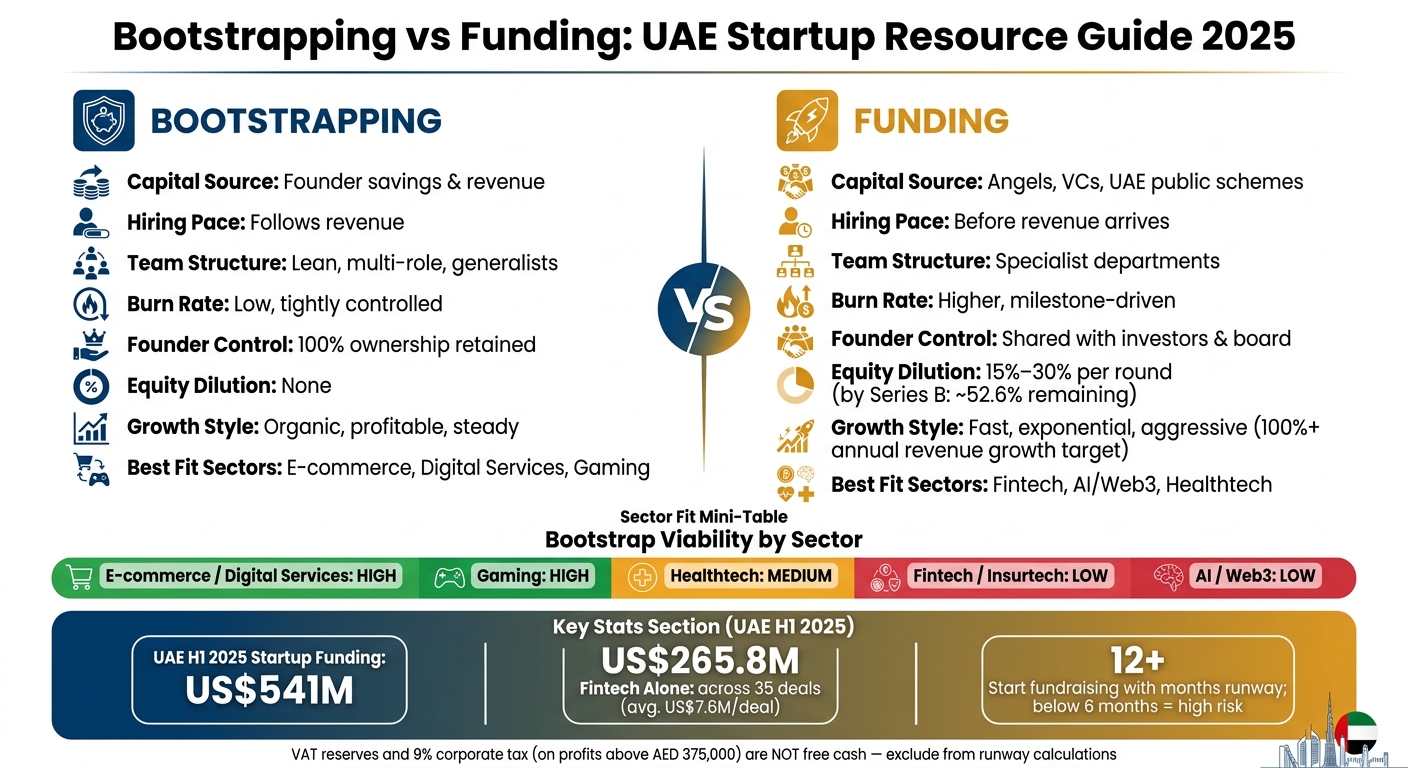
Bootstrapping vs Funding: UAE Startup Resource Guide 2025
Bootstrapping vs VC Funding Which is RIGHT for You?
sbb-itb-f597d8f
Quick Comparison
| Criteria | Bootstrapping | Funding |
|---|---|---|
| Capital source | Founder savings and revenue | Investors, angels, funds, public schemes |
| Hiring pace | Slower, tied to income | Faster, often ahead of income |
| Team shape | Lean, mixed-role staff | More specialist hires |
| Burn rate | Lower and tightly watched | Higher, tied to milestones |
| Runway focus | Cash preservation | Milestone-based spending |
| Founder control | Full or near-full control | Shared with investors and board |
| Equity | No dilution | Often 15% to 30% dilution per round |
| Best fit | Revenue-first, lower-cost models | High upfront-cost or regulated sectors |
A few numbers make the trade-off clear. In the UAE, payroll costs can include salary, visa costs, medical insurance, Emirates ID fees, and end-of-service accruals. These administrative requirements are part of the broader UAE business setup process. Funded firms may accept that higher cost base to chase growth. Bootstrapped firms usually do not. And if a founder waits until runway drops below 6 months, funding talks can become much harder than if they start with 12 months or more left.
So if you’re choosing between the two, I’d keep the test simple: How soon can you earn revenue, how much cash do you need before that, and how much equity are you willing to give up?
Hiring pace and team structure: lean growth versus hiring ahead of revenue
Hiring is often where the difference between bootstrapped and funded startups becomes easiest to spot. It affects when you bring people in, who you hire, and how fast the company grows.
How bootstrapped UAE startups add people carefully
Bootstrapped founders usually treat every hire as a fixed-cost call. In the UAE, payroll is not just salary. It also includes visas, medical insurance, Emirates ID fees, and end-of-service accruals [2].
There’s another layer too. In many UAE free zones, visa quotas are linked to workspace tier. So a single new hire can push a company into a higher office band, which means higher fixed costs [2].
That’s why many founders stay hands-on in the early stage. They often run sales themselves, ask early team members to cover more than one job, and build strong teams using contractors or dedicated product teams to plug gaps without taking on long-term overhead.
Saratov Properties is a good example. The company worked with Hexagon IT Solutions for a dedicated product team, launched an AI-enabled platform in 5.5 months, and reached profitability within 90 days without building an in-house team [6]. That kind of setup helps keep cash free for product work, sales, and a longer runway.
How funded startups build teams for speed
Funded startups tend to hire before revenue arrives. This is common in fintech and AI, where compliance and infrastructure may need specialist hires before the product even launches. The upside is speed. The downside is a higher burn rate and more management work.
| Category | Bootstrapped UAE Startup | Funded UAE Startup |
|---|---|---|
| Hiring pace | Follows revenue | Before revenue |
| Team structure | Lean, multi-role, founder-led | Specialised departments |
| Staffing mix | Contractors and part-time support | Primarily full-time staff |
| Role focus | Generalists | Specialists (engineers, growth, finance) |
| Primary risk | Slower market entry | High burn rate |
Those hiring calls shape how fast cash leaves the business. Put simply, hiring pace flows straight into burn rate, runway, and cash planning.
Burn rate, runway, and cash planning in AED
Hiring choices feed straight into burn and runway. Burn rate is the cash you spend each month minus the cash you bring in. Runway is your spendable cash divided by that monthly burn [2].
One detail trips up a lot of founders: available cash is not the same as your full bank balance. Money collected for VAT is not yours to spend. The same goes for the 9% corporate tax due on taxable profits above AED 375,000. That amount needs to be set aside [2]. If you count it as runway, your cash position can look stronger than it is.
Why bootstrapped founders focus on cash preservation
If you're bootstrapped, cash is the limit. Full stop.
With no outside funding to lean on, founders tend to keep a close grip on spend. That often shows up in short vendor terms, delays on non-essential purchases, and tight profit discipline. It’s less about moving fast at any cost and more about making sure the business can keep going month after month.
Why funded startups manage burn against milestones
Funded startups usually accept a higher burn rate, but for a reason. The spend is tied to a clear outcome, like a product launch, regional expansion into MENA, or regulatory readiness for fintech. The aim is not to save cash for the sake of it. The aim is to use cash to hit a milestone. Tracking these goals requires a robust KPI framework for startups to ensure every dirham spent contributes to growth.
That said, a higher burn rate puts more pressure on forecasting. Investors expect regular reporting, and the next round can’t be left to the last minute. A practical rule is to start fundraising when you still have 12 months or more of runway. If you wait until you’re below 6 months, you leave yourself far less room to raise on good terms [3].
That cash profile also affects growth targets and how much oversight founders are willing to take on.
Growth targets and founder control: speed, governance, and trade-offs
Once burn is set, the next call is simple: what is the money meant to buy - control or speed?
How bootstrapping affects targets and control
Bootstrapped UAE founders usually aim for profitable growth, not scale built around valuation. They keep full ownership and stay in charge, with tight spending as the norm. Every dirham goes toward keeping the business healthy, not pushing growth far ahead of revenue.
How funding changes oversight and ambition
Funded startups play a different game. Investors, especially venture capital firms, want fast growth and often look for 100% annual revenue growth [3]. That usually means spending before revenue catches up, with the goal of winning market share sooner.
That said, money from investors is not free of trade-offs. In the UAE, each funding round usually dilutes a founder's stake by 15% to 30% [1]. By Series A & B rounds, that compounding effect can leave founders with about 52.6% ownership [3]. And it is not just about equity. Funded founders also take on board oversight, investor rights, and governance duties that can shape - and at times overrule - founder decisions. This shift in control is a critical factor when preparing for a future exit.
You can see those trade-offs most clearly here:
| Factor | Bootstrapping | Funded |
|---|---|---|
| Growth expectations | Organic, profitable, steady | Fast, exponential, aggressive |
| Founder control | Complete autonomy, 100% ownership [6] | Shared with investors and board [5] |
| Dilution | None; retain all upside [6] | 15% to 30% per round; shared upside [1] |
In plain terms, bootstrapping lets founders move at their own pace and keep the wheel in their hands. Funding can help a company move much faster, but the wheel is no longer theirs alone.
Choosing the right capital path for your UAE startup
The right path comes down to three things: time to market, how much cash the business needs upfront, and how much equity you want to keep.
Once hiring, burn, and control are on the table, the next step is simple: pick the model that fits the way your business makes money.
When bootstrapping is the stronger fit
Bootstrapping works best when a business can start making money early and doesn’t need heavy upfront spend to get off the ground. E-commerce, digital services, tech services, and gaming are strong fits here. Entry costs are more within reach, and revenue can start coming in sooner.
Selfdrive.ae bootstrapped its way to profitability, while Awok raised capital only after six years of self-funded growth. [4] Those examples show that bootstrapping isn’t just a fallback. It can be a deliberate and disciplined choice.
When funding is the stronger fit
Funding makes more sense when speed-to-market pressure or compliance costs make organic growth too slow. Fintech, AI, and healthtech often come with major upfront costs, such as licensing, compliance infrastructure, R&D, and specialist talent. That kind of spend can be hard to cover through bootstrapped cash flow, especially in the early stage.
This usually means hiring and spending well before revenue shows up, which is the same pattern covered in the burn and hiring sections above. In fast-moving sectors, speed can make all the difference. The best-capitalised player often sets the pace, often leveraging investor networking to secure that lead.
In H1 2025, fintech alone pulled in US$265.8 million across 35 deals in the UAE, with an average of US$7.6 million per deal. [1] That level of capital shows what it often takes to build in a regulated, infrastructure-heavy space.
Conclusion: Match your resource strategy to your business model
Use the sector split below as a quick filter for capital fit.
| Sector | Bootstrap Viability | Primary Reason |
|---|---|---|
| E-commerce / digital services | High | Direct revenue and lower entry costs |
| Gaming | High | Engagement-led monetisation |
| Fintech / insurtech | Low | Regulatory compliance, licensing, and infrastructure needs |
| AI / Web3 | Low | High R&D and specialist talent costs |
| Healthtech | Medium | Mixed regulatory needs |
Bootstrapping fits lower-burn, revenue-led growth. Funding fits faster hiring and bigger market bets. Both need discipline, clear milestones, and a clean fit with your business model. The same logic runs across the UAE startup scene: match capital to the way your business earns.
FAQs
How do I know if my startup should bootstrap or raise funding?
Choose bootstrapping if you already have early revenue, want to keep control, or you're still working out product-market fit. It also makes sense for businesses that can grow at a steady pace without pressure to chase a fast exit.
Choose funding if your sector needs a lot of capital, growth has to happen fast, or you need major investment before revenue starts coming in. Many UAE founders bootstrap for 12 to 18 months, then raise capital when it's time to expand.
What costs should UAE founders exclude from available cash?
To get a clear picture of available cash, UAE founders need to strip out money that doesn’t actually belong to the business.
That means excluding VAT collected from customers. It also means not treating recognised revenue as cash if the money hasn’t hit the bank account yet. On paper, that income may look fine. In practice, you can’t spend what you haven’t received.
Founders should also ring-fence cash for upcoming corporate tax payments. And when planning payroll, they need to account for the full cost of each employee, not just base salary. That includes visa fees, medical insurance, and end-of-service gratuity.
When should a UAE startup start fundraising?
A UAE startup should start fundraising with 12 to 18 months of runway left. That gives founders room to negotiate from a position of strength, not panic.
A lot of founders bootstrap through the first 12 to 18 months. The goal is simple: show product-market fit, traction, and early revenue before going out to investors.
That timing matters in the UAE. Funding rounds here often take 90 to 150 days to close, so it pays to start early. Know your burn rate, map out your zero-cash month, and work backwards from there.
Related Blog Posts

Building in MENA? You don't have to do it alone.
Join 300+ founders in the Founder Connects Residency. Monthly squad calls, warm intros, $3M+ in perks, and much more. All for less than your monthly coffee budget.
Popular posts





Founder Connects is a premium MENA tech founder community. Meetups in Dubai and across MENA, Residency Squads of 8–10, and 400+ vetted WhatsApp founders (apply and screened).