

Founder Meetups in Cairo: What Tech Founders Should Expect

Building in MENA? You don't have to do it alone.
Join 300+ founders in the Founder Connects Residency. Monthly squad calls, warm intros, $3M+ in perks, and much more. All for less than your monthly coffee budget.

A Cairo founder Meetup is a conversation-led room for testing a business problem with peers, not a shortcut to investment or an assigned mentor. If you're weighing a trip from Dubai, revising your pitch or wondering whether your product would work in Egypt, arrive with a decision to make rather than a deck to circulate.
The useful outcome is someone challenging an assumption you were about to spend money on. Mentorship can grow from that conversation, but only when you turn useful advice into a working relationship with a cadence, a scorecard and a follow-up loop.
What to Expect at a Cairo Founder Meetup
Expect practical conversations about customers, hiring, distribution and fundraising readiness. At a smaller Meetup, you'll get more value from explaining a specific constraint than from delivering your company's full story.
Cairo is one of the upcoming Founder Connects cities, with a waitlist of 400+ founders, while Dubai and Abu Dhabi are the live meetup cities. Across the community, Founder Connects has hosted 900+ founders and VCs.
The OECD's review of Egypt's innovation ecosystem identifies Cairo as the concentration point of Egyptian startup activity. That concentration works in your favour. In a room where funding and talent cluster, the founder across the table is more likely to have tested the same market assumptions you hold, so one candid correction is worth more than a stack of new contacts. It doesn't guarantee that any particular investor or specialist will attend.

Bring a decision, not a general introduction
Write a short introduction covering your stage, sector, target market and the insight you need. A UAE software founder might explain that Egyptian prospects like the product but hesitate over the payment terms, then ask how local operators would investigate the objection.
Prepare differently according to your immediate constraint:
- Idea validation: Bring a customer hypothesis and evidence that might contradict it.
- Fundraising preparation: Know your revenue quality, retention, gross margin, burn and runway.
- Market expansion: Ask which assumptions about procurement, payments or customer support won't transfer from the UAE.
- Hiring: Describe the responsibility you need someone to own, not just the job title.
Use the Cairo technology startup market guide to prepare your questions before travelling.
Set realistic expectations
Aim to leave with a sharper experiment, relevant follow-up conversations and a specific request someone has agreed to consider. Those are useful outputs even if nobody discusses investment.
An investment decision will not happen that evening, and nobody assigns you a mentor at the door. Co-founders and investors are welcome at relevant Meetups; friends may attend only if they're founders or becoming founders. Seats are booked in advance and walk-ins are turned away, because room size is capped to keep the conversation useful.
Keep confidential customer information and sensitive financial documents private. You can explain a retention problem without sharing a customer list, and you can discuss runway without opening your full data room to a stranger.
Mentors, Advisors, Coaches and Peers Compared
A business mentor is an experienced operator who gives you judgement over time, not a deliverable. Their contribution is helping you make better decisions while you remain responsible for execution.
Think of a mentor as a sailing instructor who rides along through a season. An advisor is a navigator you call for a particular passage, a coach trains your technique through drills, and a peer is another crew member learning the wind alongside you.
Choose the relationship that fits the work
Mentor, advisor, coach and peer compared
| Role | Relationship | Typical cost | Best for |
|---|---|---|---|
| Business mentor | Long-term, trust-based relationship reviewed every few weeks | Usually unpaid; check any equity request in writing | Judgement on decisions over time |
| Advisor | Defined role on a topic, such as legal, pricing or hiring | Often paid or granted equity under a written agreement | Specialist answers to specific questions |
| Coach | Structured sessions built around a goal or skill | Paid per session or package | Building a habit such as sales discipline or leadership |
| Peer founder | Reciprocal exchange between founders at a similar stage | Free, with give and take on both sides | Honest feedback on the same problems this month |
Don't let the label hide the agreement. Someone calling themselves a mentor may in fact be selling consulting work, while an informal advisor may be providing thoughtful guidance without expecting payment.
The distinction is easier to remember visually.

What a mentor uniquely adds
A useful mentor can recognise the shape of a problem before you've named it correctly. They might notice that your apparent pricing problem is in fact weak customer qualification, or that a senior hire won't fix unclear ownership.
Look for:
- Pattern recognition: Experience with a comparable operating problem, including failed approaches.
- Continuity: A sounding board who remembers why you made the previous decision.
- Accountability: Someone willing to ask whether you acted on the commitment you made.
Execution support is a different job. If your problem is translating a validated customer need into a development scope, SpecStory, Inc.’s resource on how to turn validated ideas into shipped software is relevant to defining that handover, rather than expecting a mentor to manage delivery.
The startup mentor guide offers further context on choosing the relationship.
Most founders need a mix of support, not a single all-purpose expert. Check whether advice earned in a different market transfers to Egyptian procurement or UAE customer expectations before treating it as a rule.
When Your Startup Needs a Mentor
Start looking when you face an unfamiliar decision, when you're working alone on a costly problem, or when you need an honest assessment of fundraising readiness. Pricing, a first senior hire and expansion from Cairo into Dubai are all reasonable triggers.
A mentor is useful when the facts don't dictate an obvious answer. If the task already has a clear specification, you probably need someone to do the work rather than discuss it.
Read funding headlines carefully
MAGNiTT's Egypt country insights describe a funding contraction alongside stronger local investor participation. That combination matters: relationships can remain valuable even when investors become more selective about deploying capital.
More recent coverage from Ahram Online distinguishes venture capital from wider financing, including debt. ITIDA's ecosystem newsletter also reports venture capital and debt together, so those headlines shouldn't be treated as equivalent measures of equity availability.
For a founder, the implication is straightforward. Ask a mentor to challenge your milestone plan and customer evidence, not to reassure you that ecosystem activity means your round will close.
Check whether mentorship is the right tool
Before approaching anyone, answer these questions:
- Decision clarity: Can you name the decision you need help with?
- Peer testing: Have other founders challenged your current thinking?
- Desired outcome: Can you describe what useful progress would look like over the coming months?
- Scope: Could an experienced operator make the next step clearer in a focused conversation?
Say you're considering a country manager before securing repeatable demand. A mentor can help examine whether local leadership is the constraint, or whether the founders still need to learn how customers buy.
Use another route when the need is different:
- A defined deliverable: Engage an appropriate specialist for legal drafting, accounting or technical implementation.
- Missing customer evidence: Speak to prospective buyers before seeking strategic reassurance.
- A desire for approval: Pause if you only want someone to endorse a decision you won't reconsider.
Practical rule: Start looking when you can ask a question an experienced operator can meaningfully challenge in a single conversation.
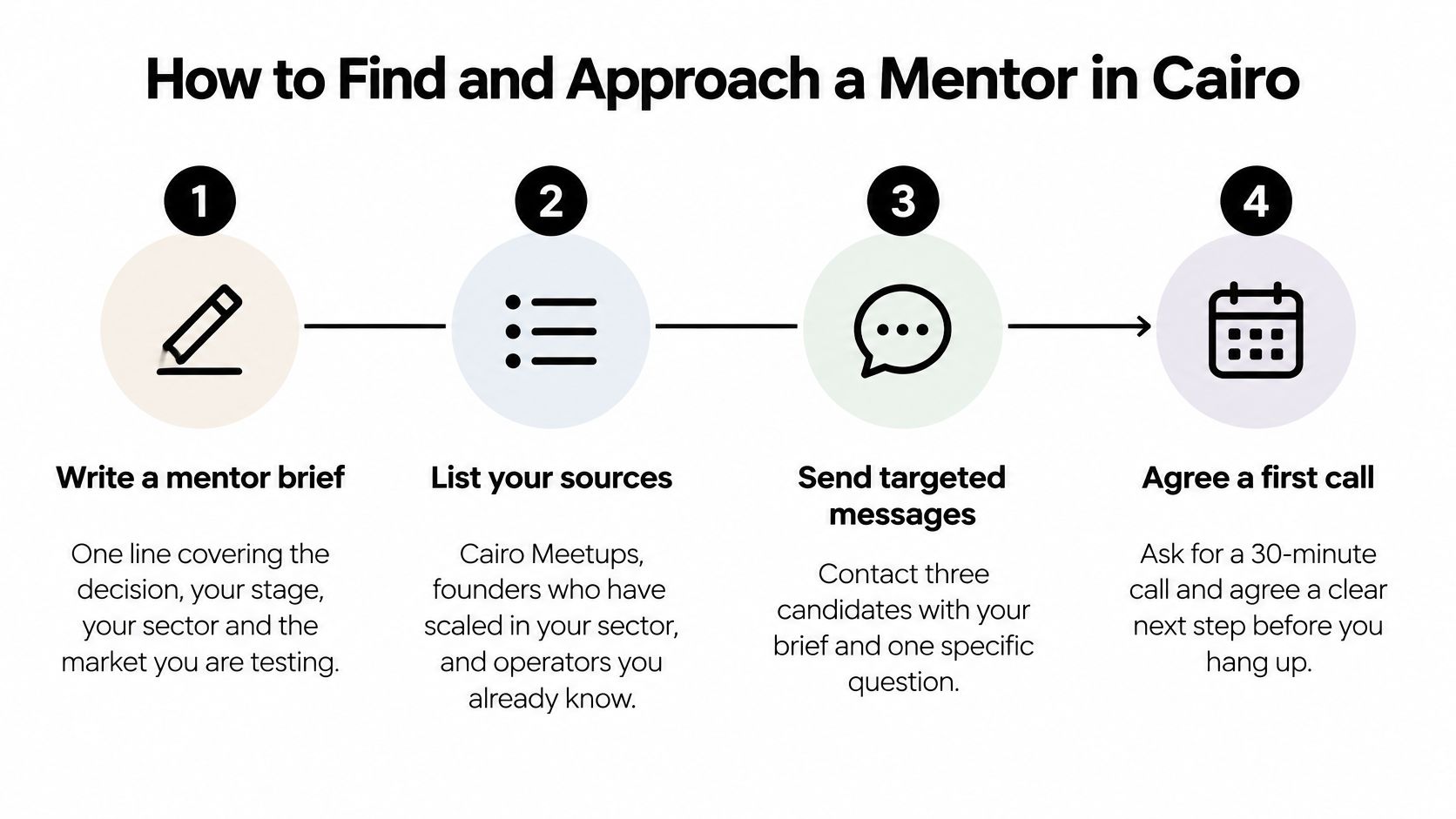
How to Find and Approach a Mentor in Cairo
A good mentor approach sounds like a short brief: the decision, the constraint and why their experience fits. Open with a bounded question they can answer or decline quickly.
Use a targeted outreach routine
Write your mentor brief. State the decision, your stage, sector and the market you're testing. For example, explain that you're deciding whether Egyptian enterprise customers need local implementation support before they'll buy.
List credible sources. Consider Meetups in Dubai and Abu Dhabi, founders who have scaled in Egypt or the UAE, sector operators on LinkedIn and peers who know someone relevant. Prioritise experience with your constraint over profile or follower count.
Choose and book your seat. Browse the Meetups calendar, select the relevant Meetup and book before attending. Walk-ins are turned away because room size is capped for quality.
Listen before asking. Notice whether the person explains trade-offs, asks clarifying questions and distinguishes experience from opinion. Then ask a specific question connected to the decision in your brief.
Send a precise follow-up promptly. Reference the actual point that helped and explain what remains unresolved. Keep the request small enough for the recipient to assess without opening an attachment.
Hi [Name], I met you at [Meetup], and your point on [specific point] changed how I think about [topic]. I'm deciding [decision] for a [stage] startup testing [market]. Would you be open to a short call to challenge my assumption about [X]?
Offer a focused trial call. Send your questions in advance and ask what context would help them prepare. If the call helps, propose a set cadence and one decision or metric you will report back on before discussing anything ongoing.
Track the exchange. Use Google Sheets or Notion to record the person, relevant experience, permission to follow up and agreed next action. Don't keep sending reminders after someone has declined.
- Relevance: They've solved a comparable problem in a similar market and can explain what differed.
- Stage fit: They understand constrained teams, founder-led sales or unfinished processes, not only mature organisations.
- Access: They have time for the agreed cadence and can say no rather than repeatedly postponing.
- Candour: They challenge an assumption and explain the evidence behind their criticism.
- Reciprocity: You both understand what they gain, whether that's learning, professional interest or a market update.
- Past mistakes: What did you get wrong at my stage?
- Disagreement: Which of my assumptions would you bet against?
- Investor readiness: What would you need to see before recommending this business to an investor?
Send a concise brief before the call. Include the decision, the evidence you have, your current interpretation and the question you want challenged. Share a readable document, not an unfiltered dashboard export.
Open with the decision and a time boundary. Explain what must be resolved and what can wait. If circumstances changed, state that immediately rather than walking through an outdated agenda.
Ask questions that test transferability. Ask which market assumption they would challenge, which part of the product needs localisation and what evidence would make them trust the business. Separate observations about Cairo from recommendations that could apply elsewhere in MENA.
Send a written recap. Record the advice, your interpretation and the experiment it will inform. Use the post-networking follow-up checklist to keep the message specific and easy to respond to.
Review the evidence while it's still useful. Choose whether to change the product, run a market test or drop the hypothesis. Give the action an owner and a review date in your existing task system.
Report the result at the next call. Explain what you tried, what happened and what remains uncertain. If you rejected the advice, explain why without turning the discussion into a defence of your original position.
- Mentor for judgement: Work through ambiguous decisions with someone who understands the commercial context.
- Advisors for specialist answers: Use defined expertise for legal, pricing, hiring or technical questions.
- Coach for behaviour: Get structured help when the problem is inconsistent sales practice or leadership habits.
- Peers for operating feedback: Compare current problems with founders who can challenge your interpretation without needing to sell you anything.
- Choose a mentor candidate whose experience fits the decision, not merely your ambitions.
- Send a bounded approach message that makes your relevance and the specific help you want clear.
- Book a relevant meetup seat and prepare the evidence you are comfortable discussing.
- Set a relationship review date before an informal arrangement becomes an indefinite obligation.
Use this visual to keep outreach focused.
Make warm introductions easy to forward
When a mutual contact offers help, write a short forwardable note. Include what you're building, why that operator's experience is relevant and the question you want to discuss.
Ask the mutual contact to check interest before sharing private details. A warm introduction gives you context and permission, while the recipient still controls their time.
The WhatsApp community includes 400+ vetted founders. Apply to join a peer pool rather than expecting someone to place a mentor for you. In a concentrated funding market, one candid challenge from an operator is usually worth more than adding another name to your contacts.
How to Evaluate a Mentor Before You Commit
A prestigious employer or successful exit isn't enough. You need evidence that the person can understand your current constraints, challenge your reasoning and make time for the relationship.
Use a trial conversation to test working compatibility. Bring a real decision with enough context to expose how they think, rather than asking broad questions about entrepreneurship.
Use a mentor scorecard
Mark each criterion as weak, credible or strong, and add a sentence explaining your judgement. An unsupported high rating is less useful than a candid note about what you still need to verify.
Don't let an impressive overall impression hide a fundamental mismatch. Excellent sector knowledge won't compensate for someone who can never meet, and warmth won't compensate for advice that ignores your cash constraints.
Ask questions that reveal judgement
Use prompts that require reflection rather than polished success stories:
Pay attention to the questions they ask back. A careful operator should want to understand your customer, evidence and constraints before prescribing a strategy.
Watch for equity or fee requests without a written agreement, promises of named investor access on a fixed timeline, or praise without scrutiny. An inability to describe a regretted decision is also a warning sign: you need reflection, not a personal sales pitch.
Commitment test: Agree a time-boxed trial, a monthly conversation and a written review date before treating the relationship as ongoing.
At the review, examine advice you acted on and whether your decisions improved. Continue because the working relationship helps, not because ending it feels awkward.
How to Work With a Mentor Week to Week
A shared document keeps a remote discussion anchored in the same evidence.

Keep a decision log
For a UAE founder testing Egypt, the log might record a recommendation to offer local onboarding. The experiment would test whether prospects actually advance through procurement when that support is available, rather than merely saying they like the idea.
Record the original hypothesis before running the test. Otherwise, it's easy to reinterpret a disappointing result as progress.
A mentor gives you judgement; you still own the decision.
Meet every few weeks unless the problem genuinely needs closer contact. Weekly calls can drift into status reporting, especially when you haven't generated new customer evidence between conversations.
Use this video as a discussion prompt, then return to your own decision and evidence.
The warning sign isn't disagreement. It's advice that never gets recorded, tested or reported back. That may still be an enjoyable conversation, but it isn't a functioning mentorship.
Common Questions About Cairo Founder Meetups
Is a Cairo Meetup worth the trip for a UAE founder?
Yes, if Egyptian market knowledge could change a live decision. Arrange relevant customer conversations around the trip, rather than relying on the Meetup alone to justify the travel.
Can a remote founder keep a Cairo mentor?
Yes. Video calls work when both people use a shared brief, an agreed cadence and written recaps. Keep sensitive documents access-controlled and confirm permission before recording a call.
Do I need to pitch at every Meetup?
No. Choose a pitch-focused format when you're ready for presentation feedback; otherwise, explain the business briefly and focus on the assumption you need challenged. Don't turn someone else's question into an opening for your sales pitch.
What if I only have a short window to attend?
Listen first, ask a bounded question and seek permission for a follow-up. A relevant conversation with a clear next step is more useful than rushing through introductions you won't remember.
Choose Your Mentor Mix Before Your Next Meetup
Early-stage founders often confuse proximity to capital with access to it. EnterpriseAM's coverage of Entlaq's startup ecosystem report describes funding concentrated in Cairo alongside limited capital reaching pre-seed and seed startups. In that environment, a warm introduction matters less than an honest assessment of whether your business is ready for one.
Candid peer feedback carries real weight here. A founder who spots a weak customer assumption can save you from spending scarce runway on a fundraising story the business cannot yet support.
Build support around the actual gap
Choose people by the job you need done:
Different conversation formats serve different purposes. A local Cairo founder event suits market-entry questions; Pitch Night suits practising your pitch and building visibility; the Coffee Series supports smaller recurring conversations; and Cofounder Match addresses a missing co-founder rather than a need for advice.
Whatever the format, keep discussions respectful, empathetic and on topic, and make room for perspectives that differ from yours. Challenge the assumption without dismissing the person who holds it.
Turn the next conversation into a test
Bring a validation brief covering the customer problem, current evidence, pricing hypothesis and the decision still unresolved. Ask each conversation partner for three things: a disconfirming observation, a relevant local example, and a person or organisation worth investigating.
Then act this month:
Treat the relationship as a working arrangement: an agreed cadence, a scorecard of the decisions you bring to it, and a follow-up loop that closes each action. Judge your support mix by the decisions it improves and the follow-through it produces.
Founder Connects is a private startup community based in the UAE, running meetups in Dubai and Abu Dhabi, with Cairo among its upcoming cities and a waitlist of more than 400 founders already open. Visit Founder Connects to explore the community and choose a conversation format that fits the decision you are working on.

Building in MENA? You don't have to do it alone.
Join 300+ founders in the Founder Connects Residency. Monthly squad calls, warm intros, $3M+ in perks, and much more. All for less than your monthly coffee budget.
Popular posts





Founder Connects is a premium MENA tech founder community. Meetups in Dubai and across MENA, Residency Squads of 8–10, and 400+ vetted WhatsApp founders (apply and screened).