

Dubai to GCC Markets: Export Playbook for Founders
Building in MENA? You don't have to do it alone.
Join 300+ founders in the Founder Connects Residency. Monthly squad calls, warm intros, $3M+ in perks, and much more. All for less than your monthly coffee budget.

If I were expanding from Dubai into the GCC, I’d keep it simple: pick one market, one entry route, and one first customer. That is the core point. Most export problems start when founders try to do too much at once.
Here’s the short version: I’d check if the business is ready, choose a market based on demand and friction, set pricing from landed cost, lock payment terms before margin slips, vet partners hard, leverage startup hubs for business growth, sort export paperwork early, and use pilots plus warm intros to land the first deal. In many cases, one delayed shipment or one weak payment term can hurt more than a slow sales month.
What this playbook covers:
- market choice
- entry route
- pricing and margin
- partner checks
- export documents
- first-customer sales process
A few points stand out straight away:
- Saudi Arabia often has the biggest pull, but setup and approvals can take more time.
- Direct export gives more control, but cash gets tied up in stock, freight, and collections.
- Distributors can lower the upfront load, but they take part of the margin and limit price control.
- Each shipment usually needs its own Certificate of Origin (COO).
- For many founders, 30 to 90-day payment terms can put pressure on cash flow if not priced in from day one.
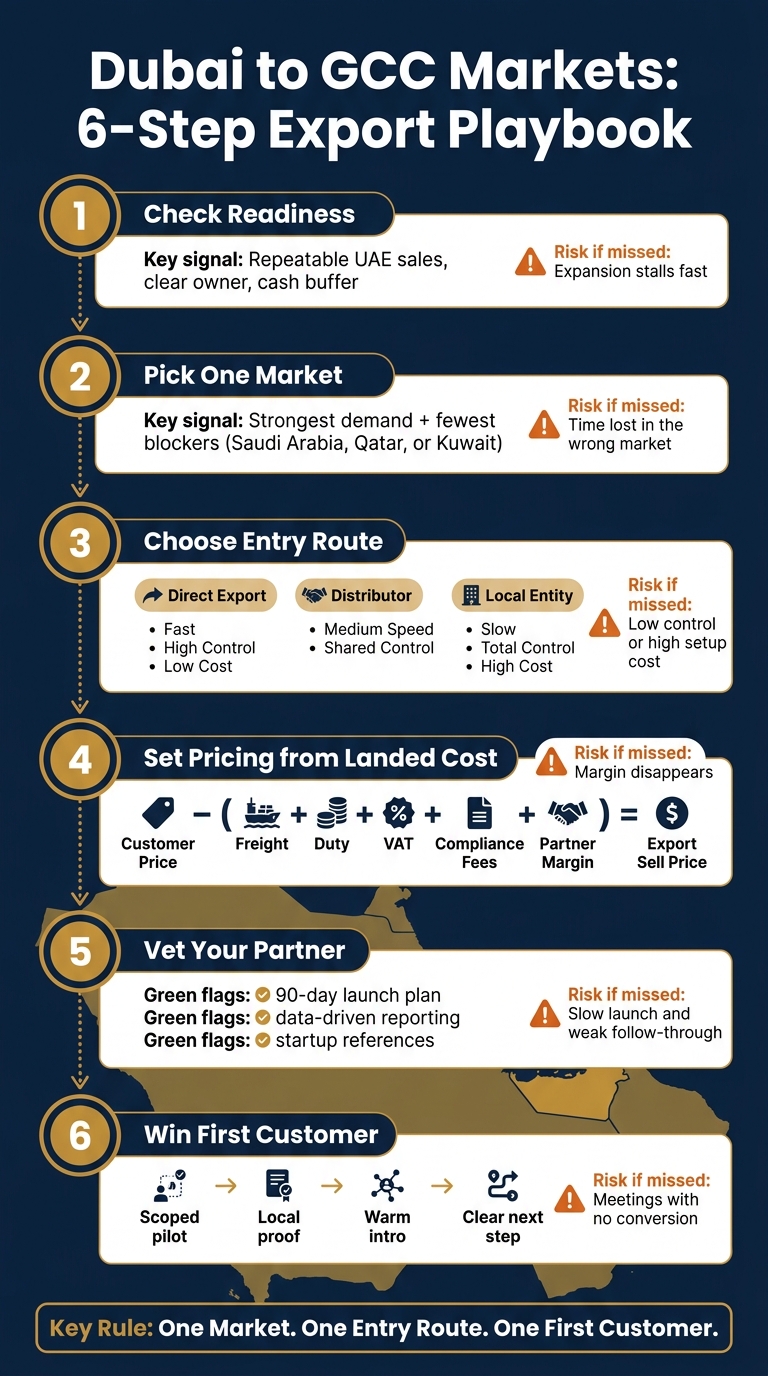
Dubai to GCC Export: 6-Step Expansion Playbook for Founders
Quick comparison
| Area | What I’d look for first | Main risk if missed |
|---|---|---|
| Readiness | Repeatable UAE sales, clear owner, cash buffer | Expansion stalls fast |
| Market | Strong demand, low friction, fit with current sales motion | Time lost in the wrong market |
| Entry route | Direct export, distributor, or local entity | Low control or high setup cost |
| Pricing | Landed cost, VAT, duty, freight, partner margin | Margin disappears |
| Partner | Clear 90-day plan, reporting, references | Slow launch and weak follow-through |
| Documents | Invoice, packing list, COO, export declaration, transport docs | Customs delays |
| Sales | Pilot, local proof, warm intro, clear next step | Meetings with no conversion |
Bottom line: I wouldn’t treat GCC expansion like a copy-paste of the UAE. I’d treat it like a sequence of six linked decisions, where each one affects the next.
sbb-itb-f597d8f
1. Choose the right GCC market and entry model
Don’t spread your first GCC push across several markets at once. Pick one market, test demand, learn what works, then expand.
How to rank your first target market
Rank each market by demand, support needs, regulation, deal size, and shipping complexity.
| Beachhead Filter | Decision Prompt |
|---|---|
| Customer Problem | Where is demand strongest? |
| Operational Support | Can Dubai support sales and service? |
| Regulatory Barrier | Does the product need local registration or approvals, such as Saudi Arabia's SFDA? |
| Deal Size | Does the contract justify the setup cost? |
| Shipping/Logistics | How hard is fulfilment from Dubai? |
Go with the market that fits your current sales motion, not the one that seems biggest on paper. Put each GCC market through these five filters. Your best starting point is usually the one with the strongest demand signal and the fewest blockers.
Direct export, distributor, or local entity: which model fits
Your entry model shapes your speed, cost, and control.
Direct export is usually the fastest and lowest-cost path. You ship from Dubai and manage customs clearance through your own team or a freight partner. A distributor can help you enter faster, but you give up part of your margin. A local entity gives you full control, but it takes more time and money to set up. It also tends to make more sense in markets like Saudi Arabia, where local presence carries more weight.
| Entry Model | Setup Cost | Speed to Market | Control | Complexity |
|---|---|---|---|---|
| Direct Export | Low | Fast | High | Low |
| Distributor | Low | Medium | Low | Medium |
| Local Entity | High | Slow (weeks to months) | Total | High |
For many early-stage UAE founders, direct export or a distributor is the best place to start. A local entity usually makes more sense after you’ve checked demand and built a pipeline that can carry the extra overhead.
The model you choose changes margin, speed, and control. It also shapes the pricing logic in the next step.
Starter market comparison table
Use this shortcut to trim your shortlist fast.
| Market | Sector Fit | Regulatory Complexity | Best First Entry Route |
|---|---|---|---|
| Saudi Arabia | Enterprise, Fintech, GovTech | High - local presence rewarded | Local entity or partnership |
| Qatar | Focused, Infrastructure | Medium | Direct export or distributor |
| Kuwait | SMEs and retail | Medium | Distributor |
Once you’ve picked the market and entry model, price around landed cost, partner margin, and payment terms.
2. Set pricing, margins, and partner terms that hold up
Once you’ve picked your market and route to market, build pricing backwards from landed cost. Start with the final customer price in your target GCC market. Then strip out every cost between your warehouse and the buyer: freight, insurance, customs duty, VAT, compliance or registration fees, and distributor margin. What’s left is the export sell price you can charge without squeezing your margin too hard.
Put simply: start with the shelf price, not your factory price.
Calculate landed cost before you set your list price
Work back from the customer price and subtract freight, duty, VAT, compliance fees, and distributor margin. That sounds simple, but small changes can hit hard. A slight shift in freight, duty, or partner margin can move your export price more than expected.
You also need to account for FX risk and working-capital timing. If part of the cost base sits in another currency, or if payment lands well after shipment, cash can get tight fast. A deal may look fine on paper and still put pressure on the business once the invoice cycle starts.
Once landed cost is clear, the next step is to pressure-test the partner’s payment terms against your cash flow.
Set payment terms you can actually finance
Start with upfront, partial-upfront, or short-credit terms until the partner has built a record of paying on time. That gives you some protection while the relationship is still new.
You should also price in anything that adds cost or risk, such as:
- exclusivity
- MOQ
- returns
- marketing support
- Incoterms
Only shift to longer credit terms when payment behaviour has been proven over time.
That’s why channel model and payment terms need to be priced together. If you treat them as separate decisions, margin can disappear without much warning.
Pricing by channel model: a comparison
Use the channel model to test both margin and cash impact.
| Channel Model | Margin Retained | Cash Tied Up | Speed to Market | Pricing Control |
|---|---|---|---|---|
| Direct Export | High | High | Slow | Total |
| Single Distributor | Medium | Low (partner carries inventory) | Moderate | Shared |
| Multi-Country Distributor | Low | Very low | Fast | Limited |
A single distributor usually gives up some margin in exchange for speed and local reach. A multi-country distributor can get you into market faster, but you give up more control and price discipline tends to weaken.
With pricing set, the next step is partner selection and compliance paperwork.
3. Find partners, prepare documents, and ship compliantly
Once your pricing model is set, the next job is simple in theory and messy in practice: pick the right partner and get your documents in order before the first shipment leaves.
A good partner should fit the route to market you already chose. They shouldn't push you into a different model just because it's easier for them. You also need to check whether they can handle logistics, registration, and compliance, not just make introductions and promise access.
Be direct. Ask operational questions, not broad ones. Ask for specific examples of delays, how they fixed them, and what they did in the first 90 days after launch.
| Assessment Category | Green Flag | Red Flag |
|---|---|---|
| Operational Depth | Can explain past launch problems and fixes | A weak one will avoid specifics |
| Reporting Discipline | Provides clear, data-driven reporting frameworks | Relies on informal updates and connections |
| Launch Support | Has a 90-day launch plan | Vague about specific execution steps |
| Reference Checks | References from similar-stage startups | References only from large corporates |
| Regulatory Knowledge | Maps compliance early | Treats compliance as an afterthought |
That table helps, but don't stop there. You also need to see if the partner can adjust the customer experience, fulfilment, and market positioning for the market you're entering, not just translate your brochures and sales deck.
Once you've shortlisted a partner, move straight to the document pack. That's where delays usually begin.
Export documents UAE founders need to prepare
Clean paperwork protects cash flow just as much as it protects compliance. In most cases, you should prepare:
- PO
- Incoterms
- commercial invoice
- packing list
- COO
- export declaration
- transport documents
- insurance
Each shipment needs its own COO to support customs clearance and preferential treatment.
If you're operating from a Free Zone, you need to register with Dubai Chamber to get access to COO issuance and attestation services. Mainland companies often get faster turnaround times. If you are still in the early stages of setup, consult a UAE accelerators and incubators guide to understand which ecosystem support best fits your export goals. If the process involves several attestations or legalisations, using a PRO can save time and back-and-forth.
For tech and SaaS exports, prepare attested contracts, service invoices, and any company documents the buyer or regulator asks for. If you're exporting fintech services, you'll also need regulatory clearance in the target market.
A small mismatch can slow everything down. Keep digital copies of your trade licence, MOA, partner IDs, and Emirates IDs ready to go. Also make sure your trade licence activity matches your export application.
Different product categories trigger different checks, so match the paperwork to the product before shipping.
Document and compliance requirements by product category
| Product Category | Likely Documents Required | Key Regulators / Checks |
|---|---|---|
| Packaged Goods | Commercial Invoice, Packing List, Certificate of Origin (COO) | Dubai Chamber, UAE Customs, Health or Food Authorities |
| Electronics | Commercial Invoice, Packing List, COO, Technical Specs, Export Declaration | Dubai Chamber, Telecommunications and Digital Regulators |
| SaaS & Tech Services | Attested Contracts, Service Invoices, Attested MOA | Dubai Chamber (Attestation), Central Banks (for Fintech), Federal Tax Authority |
Use an ATA Carnet for temporary exports to trade shows or demos.
With your partner and paperwork sorted, the final move is turning those approvals into first sales.
4. Win your first GCC customers and build a repeatable sales process
With your partner in place and your paperwork sorted, the next job is simple to describe and hard to do: turn interest into a first order. This is where a lot of UAE founders get stuck.
Run outreach that fits GCC business culture
Go straight to the actual decision-maker. If you reach out to the wrong person, the deal usually goes nowhere. Check seniority first, then send your message.
Make each message specific to the buyer’s market and problem. A note tied to compliance friction, supply chain visibility, or a clear sector gap will land far better than a generic intro. Mass outreach tends to fall flat here.
Timing also plays a big part. Work around the Sunday-to-Thursday business week, and plan in advance for Ramadan and Eid. When you respect the local pace of business, it becomes much easier to get replies and secure meetings.
For formal introductions, Dubai Chamber or the relevant Chamber of Commerce in your target market can give you a recognised first handshake. That carries extra weight in places where institutional trust matters a lot, such as Oman and Saudi Arabia. End every meeting with one clear next step, such as:
- an introduction to a sector committee
- a named local contact
- a confirmed follow-up date
Use pilots, references, and community credibility to close first deals
A scoped pilot or trial order can help get that first yes. Set the success metrics upfront so both sides know what “working” looks like. Then, once the pilot delivers, use that result as your lead proof point.
If you already have a UAE case study in the same sector, put it front and centre. That kind of proof travels well. And in many cases, a warm introduction from a trusted advisor or investor can do more than months of cold outreach. Joining UAE startup communities is often the fastest way to build these relationships.
A warm introduction through Founder Connects can help open doors with advisors, investors, and peers in the UAE startup community.
Conclusion: The six decisions that make GCC expansion work
GCC expansion is not complicated, but it does need to happen in sequence. One bad call early on makes the next step harder. Get the order right, and each step supports the next.
The six decisions that shape the outcome are these: pick one priority market and go deep before spreading wide; choose an entry model that fits your current operating capacity; price for landed margin, not UAE shelf price; verify your partner before you commit; get your documents ready before the first shipment moves; and treat first-customer outreach as a trust-building process, not a volume game.
In practice, a well-placed introduction, backed by a credible pilot and a local reference, will usually beat broad cold outreach.
FAQs
How do I know if my business is ready to export from Dubai?
Your business is ready when your UAE sales base is stable and you can handle expansion without exposing weak spots. Look closely at product, revenue, team, finance, and operations. If you’re seeing more yellow or red flags than green, sort those out first.
A few signs usually stand out:
- Sales are repeatable without the founder needing to step in all the time
- You have 12 to 18 months of cash runway to cover slower ramp-up periods and 60 to 90 days payment cycles
- Your business can handle compliance, data residency, bilingual invoicing, and there’s clear demand in the market
That matters because expansion puts pressure on everything at once. A business might look fine day to day, then start to wobble when new customers, extra admin, and cross-border demands all hit together. It’s a bit like adding another lane to a road before fixing the bottleneck at the junction.
If the foundations are steady, growth is far easier to manage. If they’re not, the cracks tend to show fast.
Which GCC market should I enter first?
Don’t pick a market on size alone. Start with the GCC market that gives your business model the best shot at controlled success.
Saudi Arabia often works well for enterprise contracts, institutional trust, or premium positioning. But a smaller, tighter market can be the smarter first move if you need one anchor client or if your offer depends on a certain regulatory setup. In plain terms, the biggest market isn’t always the right starting point.
A good rule: go where you already have a warm introduction or clear demand. That can save time, cut friction, and give you a cleaner path to early wins.
What documents do I need for my first export shipment?
For your first GCC export shipment, make sure every document matches exactly. Even small differences in company names, dates, shareholder details, or authorised signatories can slow things down.
You’ll usually need:
- Certificate of Origin (COO)
- commercial invoice
- packing list
- shipment details
It also helps to get the presentation right from day one. Prepare bilingual Arabic-English invoices, use permanent Arabic labelling for consumer goods, and submit product data with 12-digit HS codes through digital e-clearance systems such as Dubai Trade.
Related Blog Posts

Building in MENA? You don't have to do it alone.
Join 300+ founders in the Founder Connects Residency. Monthly squad calls, warm intros, $3M+ in perks, and much more. All for less than your monthly coffee budget.
Popular posts





The premier community for tech founders, investors, and builders. Connect, collaborate, and grow together.